One of my favorite comedians, George Carlin, once said, “The caterpillar does all the work, but the butterfly gets all the publicity.”
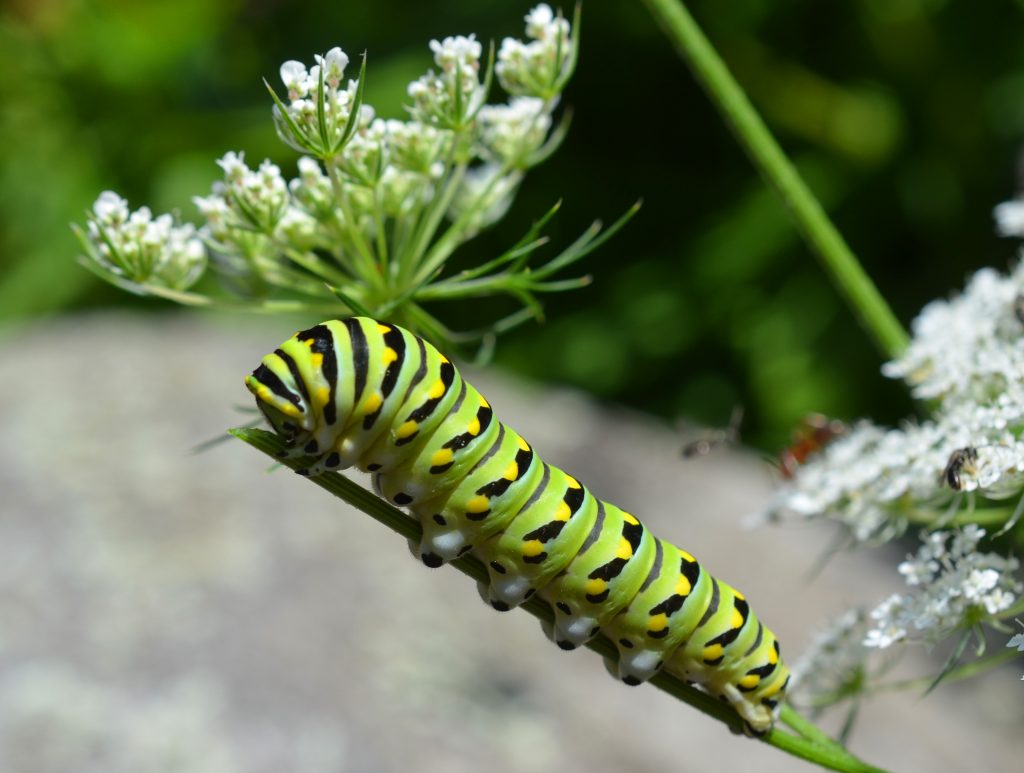
The larva stage (caterpillar) of the Black Swallowtail butterfly feeds on Queen Anne’s Lace wildflower
They crawl, they eat, they eat some more, and then they curl up and metamorphosize-changing into a chrysalis or cocoon. As a matter of fact, caterpillars only have one job-to eat as much as possible in the time they have. They eat so much they may increase their body mass by 1000 times, or more!
Milkweed Tussock Moth caterpillars munching away!
Caterpillars are the larval stage of butterflies and moths. Most of these winged insects go through what’s called complete metamorphosis. They start as an egg, hatch into a larva (caterpillar), then go into a dormant stage called a pupa (cocoon or chrysalis), then eventually emerge out of the pupa stage as adults, and fly away. It’s the larval/caterpillar stage that eats the most, although many adult butterflies and moths also feed, primarily sipping nectar from flowers, tree sap and other plants. We may be familiar with one stage of the insect, but not the other.
A Duskywing moth begins to spin its cocoon where it will spend the winter, then hatch as an adult in the spring.
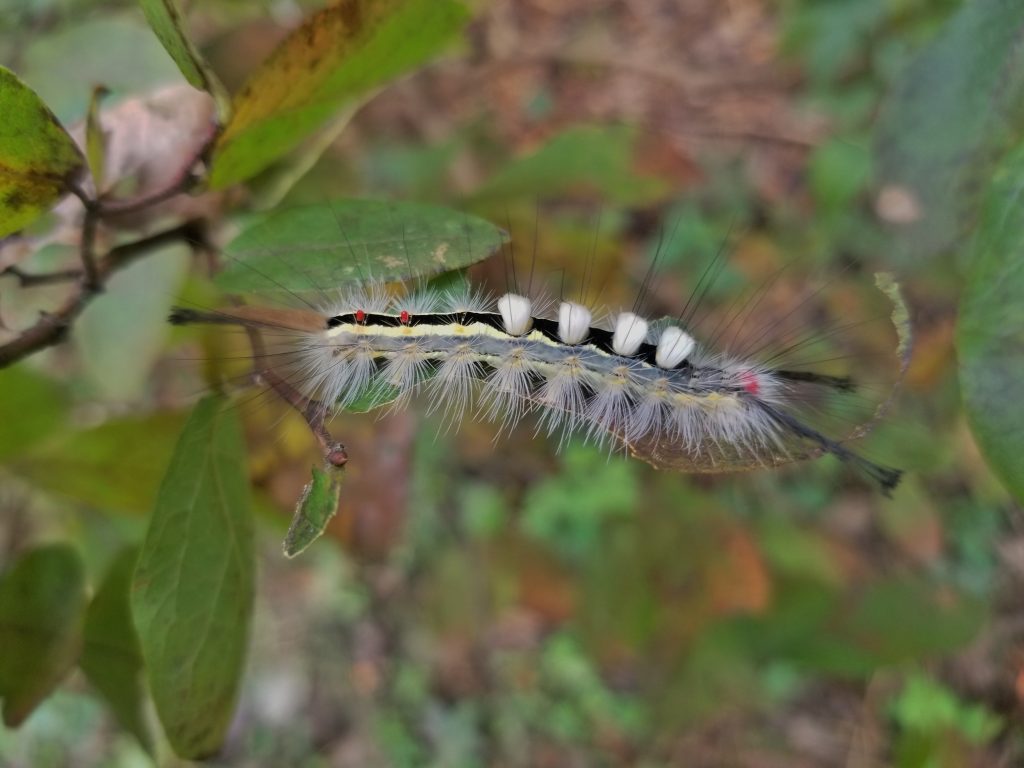
White-marked Tussock Moth caterpillar
Many of us easily recognize the beautiful black and orange colors of the adult Monarch butterfly, a welcome visitor to our backyard gardens and meadows, which are well-known for their long migration south to Mexico. But we may not be as familiar with its caterpillar, which feeds primarily on members of the milkweed family, and is really cool-looking in its own way! Or, the spectacular, 7”, lime-colored adult Luna moth, with its long tails on its hind wings, but have never laid eyes on the chunky green caterpillar! However, in some species it’s the caterpillar we know, and not so much the adult.
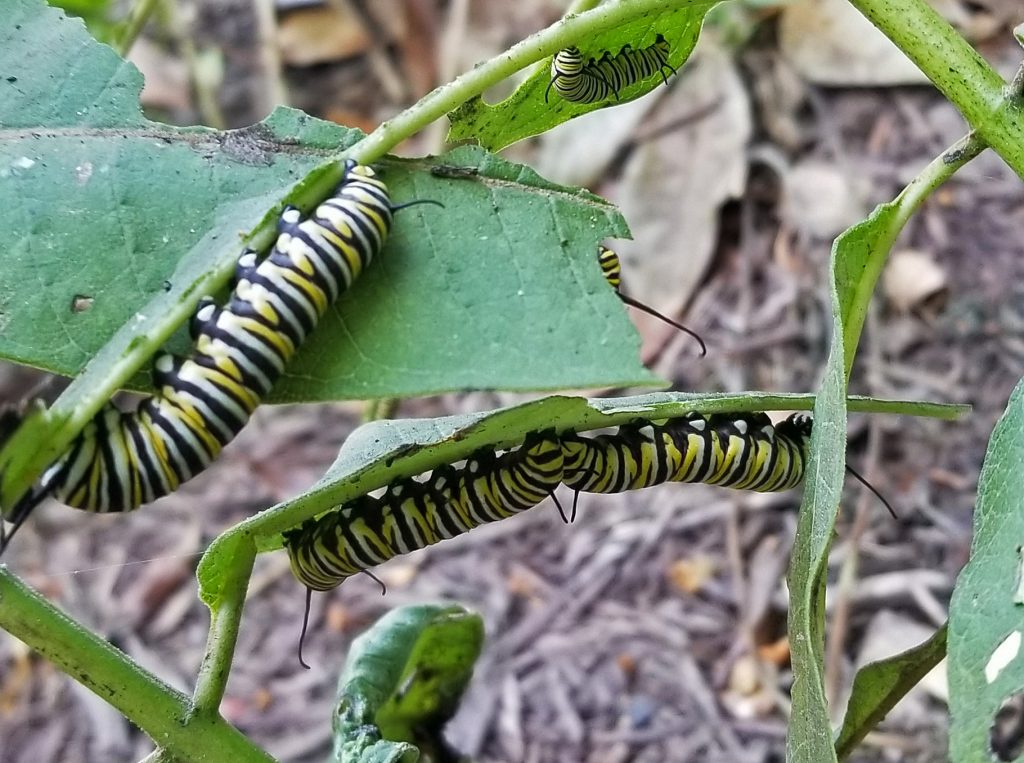
Monarch butterfly caterpillars voraciously feed on the leaves of milkweed plants.
A young Spicebush Swallowtail caterpillar
For example, do you know what kind of moth the “famous” Wooly Bear caterpillar turns in to? Answer: The cool-looking, orange Isabella Tiger Moth! How about a caterpillar that’s responsible for the loss of thousands of acres of hardwood trees? As a matter of fact, we may not even identify this small fuzzy caterpillar with blue and red markings, but when they get together, I bet many of you have seen the devastation they can cause. Answer: the Gypsy Moth. Usually hatching by the millions, an outbreak of these small critters can completely defoliate (eat the leaves) huge sections of trees, which can negatively impact a forest ecosystem, and possibly lose millions of dollars in commercial value. They start gorging themselves in the spring when the leaves are just emerging and the trees are most vulnerable. The adult is a small, rather plain brown, or tan moth and doesn’t even eat!
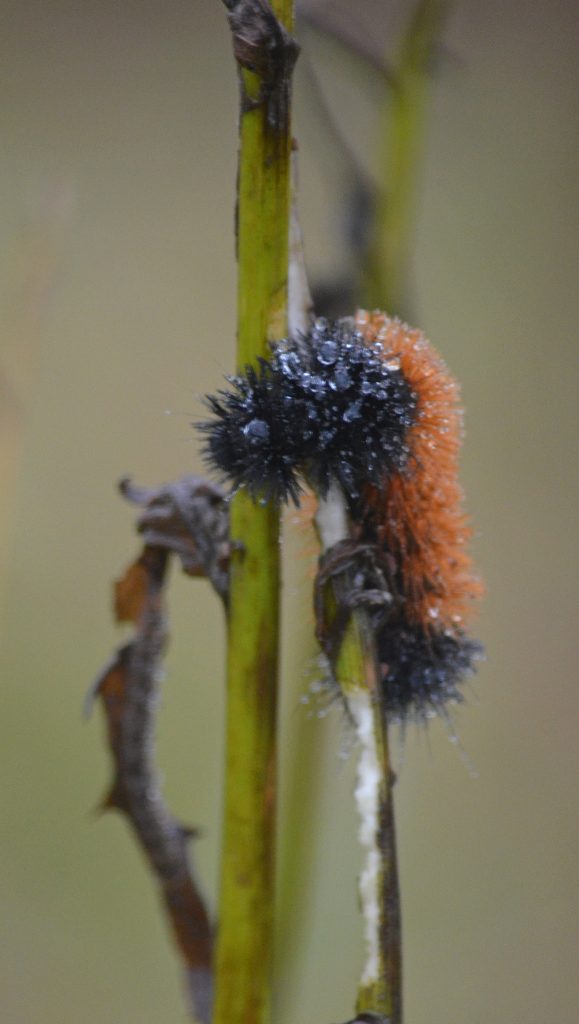
Banded Wool Bear caterpillar
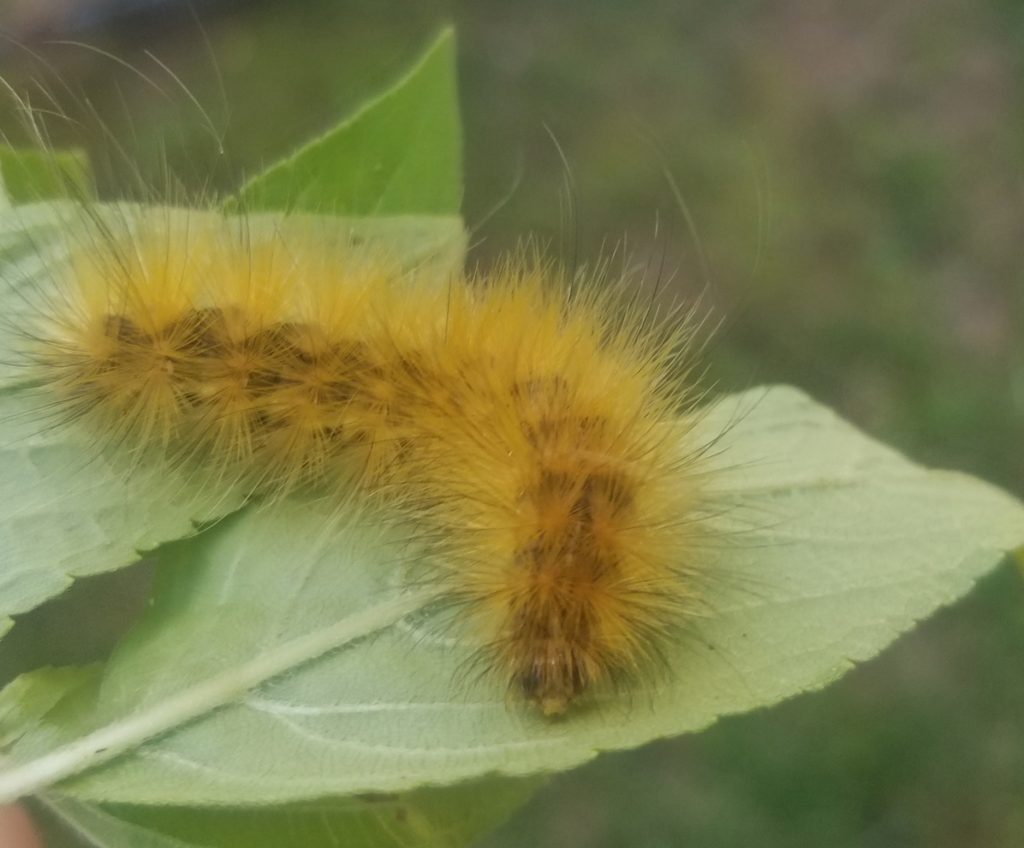
Yellow Wooly Bear caterpillar
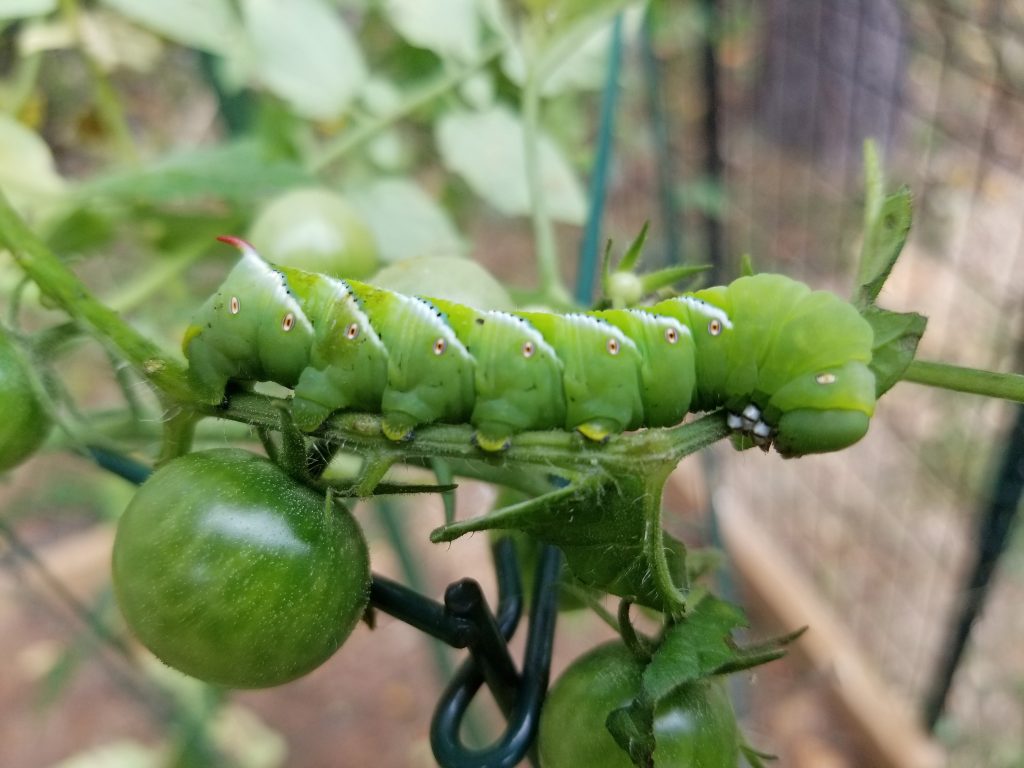
The garden pest Tomato Hornworm caterpillar -the adult is called a Five-spotted Hawk moth, or sphinx moth.
The Caterpillar of the Year in our backyard was the dragon-looking, 6″ long Hickory Horned Devil, which turns into a Regal Moth! Wow!
If there’s one group of critters that has stood out more than any other animals to me around our home this year, it has to be the caterpillars! I’m not sure if it’s because we’ve spent more time at home due to Covid-19, or that all of our plantings and mini-land management projects, like the meadow restoration, are now creating more suitable habitat for these crawlers, and the flying adults. It’s most likely both! But, we have noticed more birds around this year too. Again, isolation at home can make you more aware of your natural surroundings, but usually when bird populations increase, it’s because their food supply (and nesting habitat) has increased as well. Everything in nature is connected! But when I did the math, if I ate as much as a caterpillar eats, as to increase my body mass by 1000x, I would be about 93 tons, or almost the size of a Boeing 747 jet! Man that’s a lot of leaves!
I could start to feel the back of my neck getting sore, almost like I was experiencing a small cramp. It happens every year from about mid-September through the end of October, almost every day. I’ve been experiencing this temporary discomfort since I was 10 years old, and hopefully, will continue to experience it until I fade away! As weird as it sounds, I look forward to the neck ache every autumn! Why? Because it signals the start of one of the greatest shows on earth-the annual fall raptor migration! The constant tilting of my head looking toward the sky in search of these beautiful birds passing overhead is what causes the soreness, many times I’m also holding binoculars up to my eyes as well. But every hawk that I get a chance to see makes it so worthwhile!
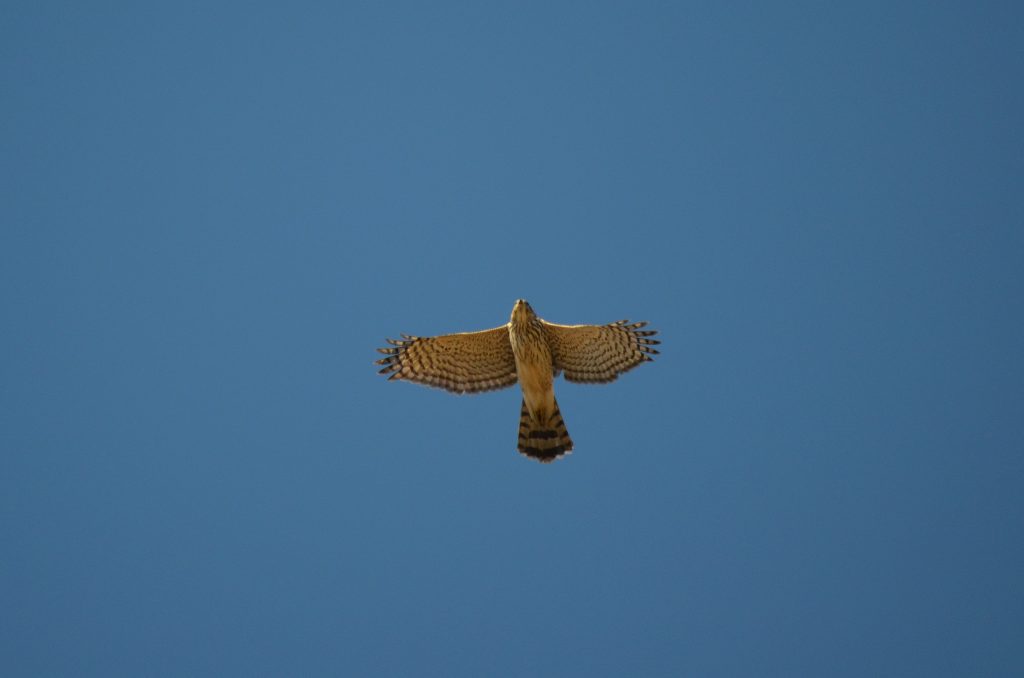
Sharp-shinned Hawk (top) and a Red-tailed Hawk (bottom)
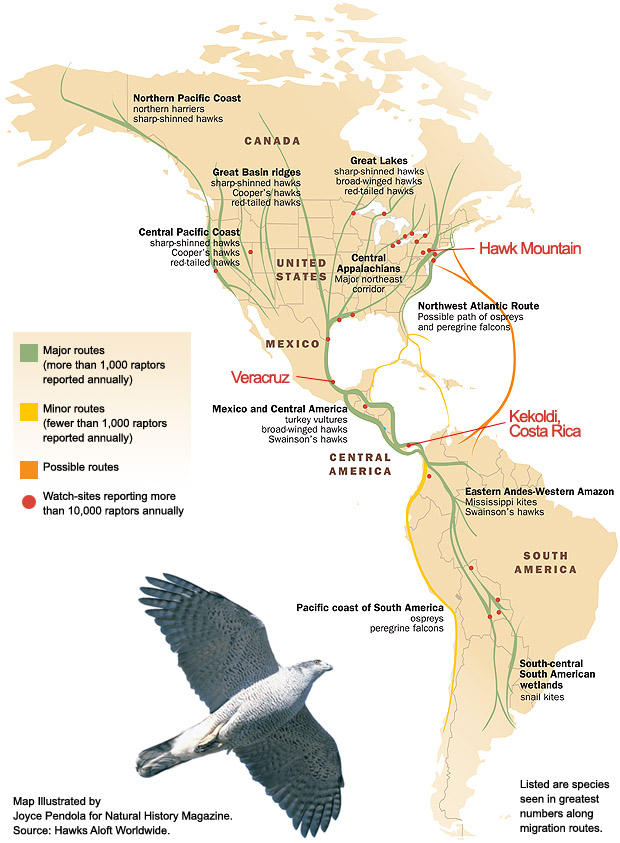
The “show” starts as early as late August, and may continue until early December, but September and October are the prime months. Here in the Eastern U.S. during this time period thousands of hawks, eagles, falcons, kites and vultures make their way south along ridges of the Appalachian Mountains or along the Atlantic coast. Raptors also migrate through the Central and Western U.S. as well. The most popular time is probably mid-to late September, when thousands of Broad-winged Hawks will migrate south, many times in flocks of hundreds of birds, called kettles. The premier spot for hawk watching in North America is Veracruz, Mexico. Each fall, 4-6 million raptors migrate through Veracruz on their way to winter ranges in Central and South America. Because of the region’s geography, raptors from eastern, central, and western North America converge, providing visitors with a display unequaled anywhere on the planet.
Hawk watching, as it’s now known, has become quite popular in the past couple decades, with thousands of people visiting designated “Hawk Watches” throughout the United States, Canada and Mexico. It doesn’t take much, but a decent pair of binoculars helps. The added bonuses are that you’re usually watching them from very scenic sites during a great time of year, meet some great people, and can see lots of other migrants passing by as well. It’s not unusual to spot a variety of songbirds, waterfowl, monarch butterflies and dragonflies (yes, these migrate as well).
View from a local Hawk Watch
On several occasions I’ve also seen skydivers, several blimps and military fighter jets (including a Stealth). Since most hawk watches are covered by volunteers, it’s also become a very important aspect of citizen science that significantly contributes to critical raptor conservation. The Hawk Migration Association of North America collects hawk count data from almost 200 affiliated raptor monitoring sites throughout the United States, Canada, and Mexico. The organization is a driving force behind the Raptor Population Index (RPI), to promote scientific analysis of hawk count data. It also provides Hawk Count (www.hawkcount.org), a near-real-time international database of hawk counts across the continent. One of these is Hawk Mountain, in SE Pennsylvania, probably the most famous Hawk Watch in America. Its name reflects both its inauspicious past and its very bright future.
Amazing numbers of hawks migrating-Corpus Christie, Texas Hawk Watch Photo courtesy of Gunnar Pettersson Photography
Located north of the small village of Kempton, Hawk Mountain was once the site of the slaughter of countless hawks shot down by gunners during the birds’ annual migration along the Appalachian Flyway. Today, however, the ridge that straddles the Berks-Schuylkill County line stands as a shining example of conservation success – a 2,500-acre wildlife refuge known around the world for its groundbreaking role in protecting raptors and their habitat.
Rosalie Edge-Photo courtesy of Hawk Mountain Sanctuary Association
The world’s first refuge for birds of prey, Hawk Mountain Sanctuary was founded in 1934 by New York conservationist Rosalie Edge after she saw photographs taken by amateur ornithologist Richard Pough. After visiting the mountain, Edge leased approximately 1,400 acres, naming Maurice Broun as Hawk Mountain’s first warden and ending the shooting of raptors on the ridge. Officially incorporated as Hawk Mountain Sanctuary in 1938, today the refuge is widely respected as a leader in raptor conservation and research work. It’s also an excellent destination for experiencing wildlife and the outdoors, offering visitors of all ages the opportunity to catch glimpses of more than 20 different raptors during their annual fall migrations.
Northern Harrier
Osprey
Adult Bald Eagles migrating
Turkey Vulture
Growing up in Pennsylvania, a trip to Hawk Mountain became an annual “migration” for me too. It started with my dad and I in the early 1970’s and 80’s. Then, two decades later, I was excited to introduce Hawk Mountain to my wife Theresa and sister, Cathy, and we tried to continue our tradition of visiting “The Mountain” at least once, every fall. However, back in the day, it was just me, Pa, our gear and food! Like a kid on Christmas Eve, I would eagerly pack our daypack the night before with binoculars, field guides, and lunches and snacks. Our food usually consisted of turkey sandwiches, chips, slices of ring baloney, a few apples and a half gallon of chocolate milk. We would leave before daylight and drive the 2 hours south to Hawk Mountain, from our NE Pennsylvania home. We always left early enough to navigate our way to a Mister Donut shop (precursor of Dunkin Donuts) for an egg sandwich and a jelly-filled doughnut! Pa taught me early on that a good birding trip was only as good as the food you ate along the way! Pa was right, and my wife and sister understand that, even today, “good munchies” are still required for any birding trip we plan together!
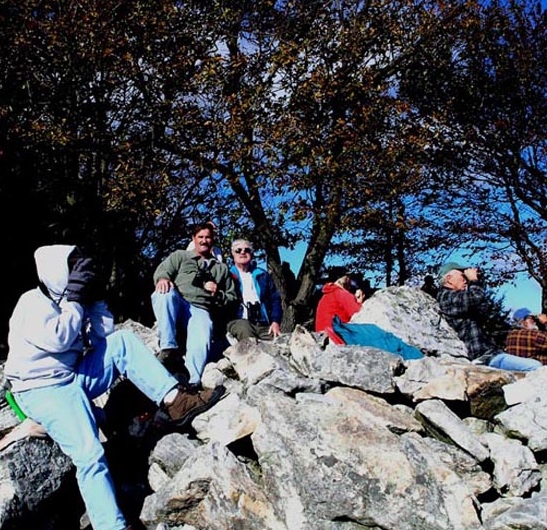
Pa and I sitting on the North Lookout of Hawk Mountain (early 2000’s)
Upon our arrival at Hawk Mountain the ritual was always the same-quick bathroom break, pay our entrance fee and head straight to the North Lookout-a good, challenging 1.25 mile hike that ends at a large outcrop of rugged boulders. These massive rocks is your seating for the day-no chairs, benches or picnic tables here. Only rocks to sit on, with sensational 180-degree views of the Kittatinny Ridge straight in front of you, and the valleys below! Here you sit, as Pa, Theresa, Cathy and I have for nearly 40 years. As did thousands of people before us, and thousands of people since. You watch, you look and you listen, as “official counters” shout out migrating birds over distant landmarks, with odd names such as The Pinnacle, Donut, Hunter’s Field and Owl’s Head. It may not be an activity for everyone, but for those who enjoy the outdoors and nature, Hawk Mountain is a magical place. A place to sit, observe, reflect and marvel at these beautiful migrating birds.
Official counters of Hawk Mountain up on the North Lookout. Photo courtesy of Linda Weller
Although we now live in Virginia, we’re still blessed with great hawk watching, as we live adjacent to the Blue Ridge Mountains, and have easy access to another fantastic Hawk Watch only 15 minutes from our home, called Rockfish Gap. This site also tabulates big numbers of migrating Broad-winged Hawks (the 2020 count so far is 29,279) each year, and as many as 14 other species as well.
A small kettle of Broad-winged Hawks over our house in Virginia (9/21/20)
As the official fall season sneaks in today (September 22nd), the hawks are once again on the move, soaring and winging their way south, thousands of miles to their wintering grounds. They come from the far reaches of Canada and northern U.S., some by themselves, others in large flocks. I know this because, once again, the back of my neck is sore from gazing toward the sky….I wouldn’t want it any other way! Cheers!
As I watched from my vista along the Blue Ridge Parkway on an early Sunday morning, the fog rolled through the valley like a slow motion wave on the ocean. The Blue Ridge Mountains held their towering grip over the valleys below, not allowing the advancing mist to creep up its slopes as the sun began to burn through.
Traversing nearly 470 miles up, down and in some cases through the Appalachian Mountains, the Blue Ridge Parkway is one of America’s most beautiful scenic routes. The route has ending points near Cherokee, North Carolina, and Waynesboro, Virginia. Although it was originally created as a jobs project, the route remains well traveled by those looking for a scenic view of the mountains in the southern United States. It is generally not hard to find your way around the Blue Ridge Parkway. Each mile of the journey has a designated mile marker and most attractions have been noted by the mile marker they are closest to. Also, at each entryway to the Blue Ridge Parkway is a signpost pointing north and south. South will take you toward Cherokee and north toward Waynesboro.
The morning sunlight shines through the trees along the Blue Ridge Parkway in VA
The Blue Ridge Parkway began construction on September 11, 1935. At this point, the United States was struggling to pull itself out of the Great Depression. President Franklin D. Roosevelt pushed for a number of different public works and highway infrastructure projects, including the Blue Ridge Parkway. Over the years, construction peaked and slowed, with the last major section completed in 1987, more than 50 years after the first section of road was put down.
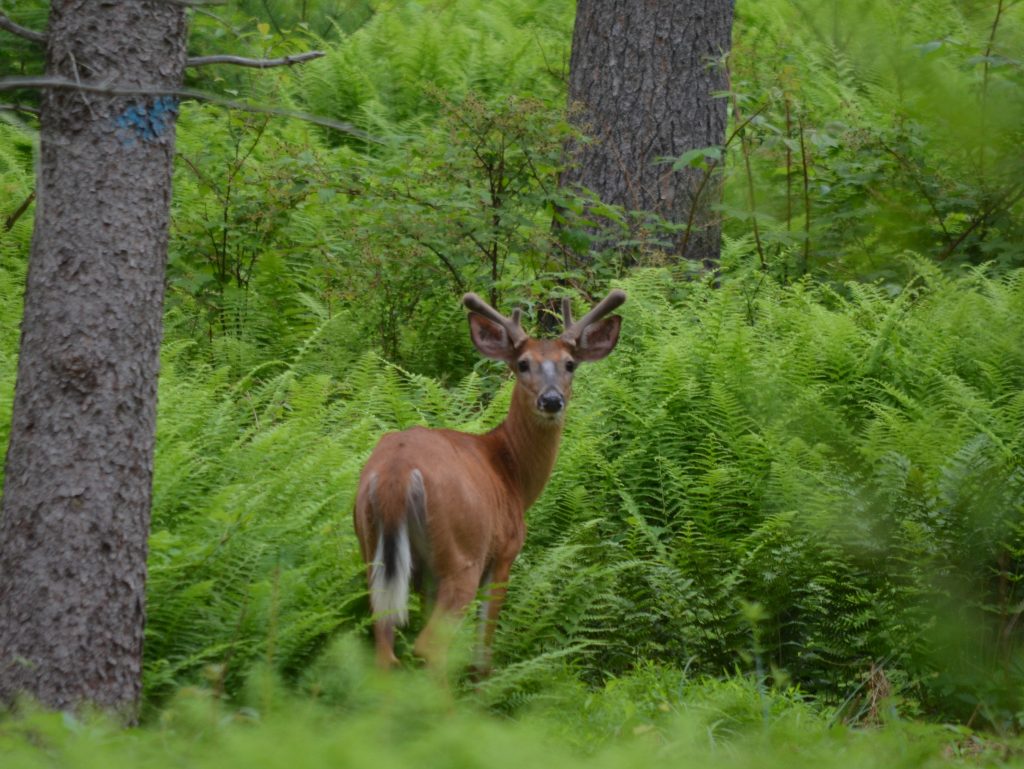
As you travel along the Parkway there are many overlooks to pull off the road and enjoy the views, stretch your legs or even go for a hike. Since the Blue Ridge Parkway is owned and operated by the National Park Service (NPS), there are plenty of places where the park service owns adjoining lands to enjoy passive outdoor recreation. Since we’re very fortunate to live so close, I venture up there several times a year to go birding, take some photos or just wander. If you go early in the morning, or late afternoon, you have a good chance of spotting a variety of birds, deer or even Black Bear. With viewscapes looking in many directions, abundant wildlife viewing opportunities and a rich, cultural history, the Blue Ridge Parkway is one of America’s most treasured drives! If you find yourself heading down this way, take a few hours to get off the major highways and detour yourself along the tops of the Blue Ridge Mountains! Enjoy!
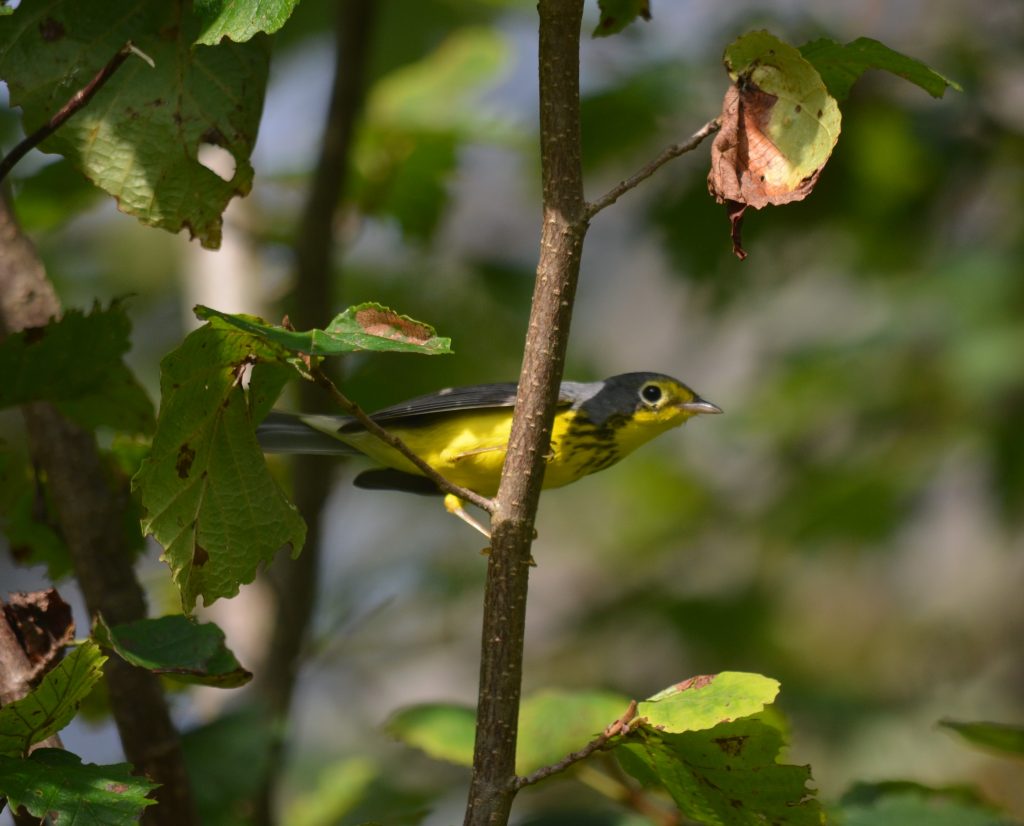
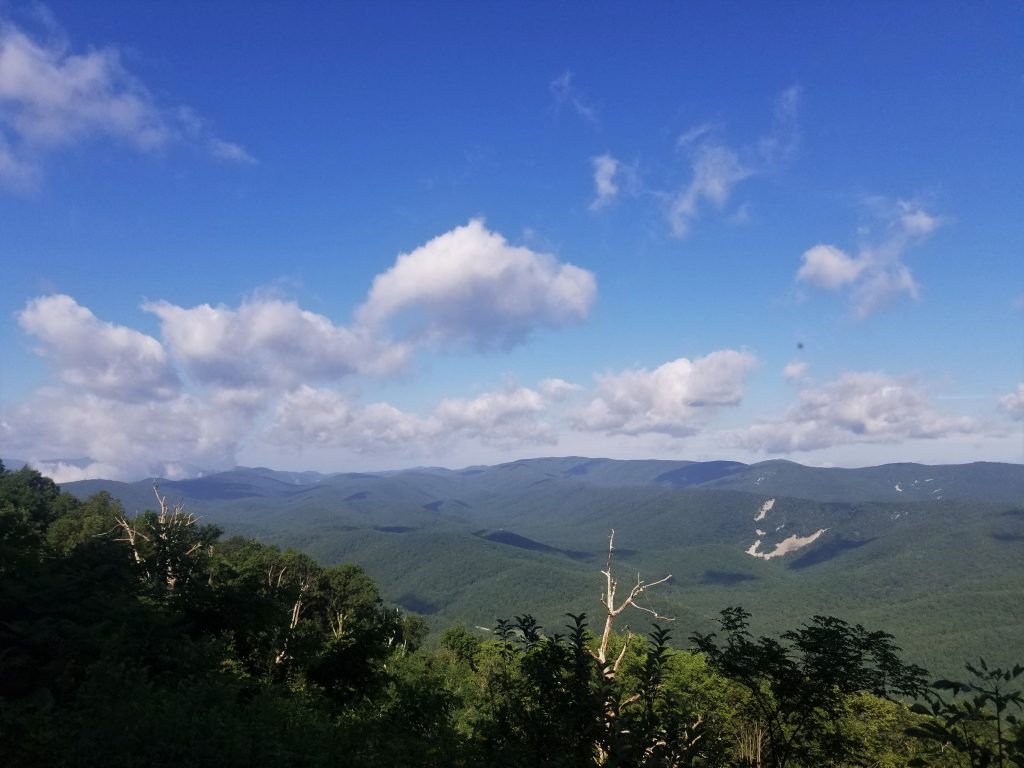
A Spicebush Swallowtail rests on a Turks Cap LilyA young Canada WarblerEarly signs of fall on a Sassafras TreeViews from the Blue Ridge Parkway overlooking the George Washington National Forest
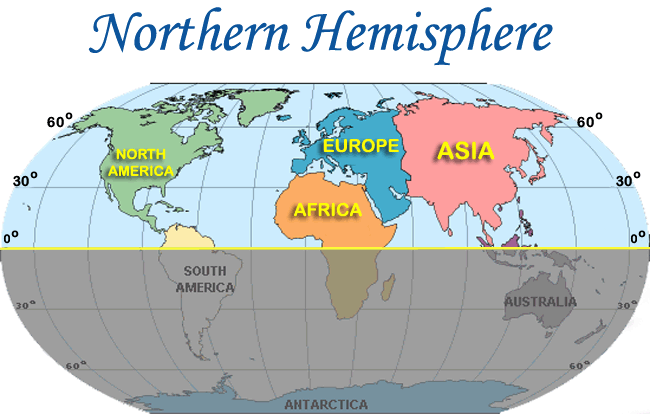
At precisely 5:43 pm today, Saturday, June 20, 2020, we mark the Summer Solstice in the Northern Hemisphere-the day with the maximum amount of daylight hours where we live. While we celebrate the beginning of our summer, my family and friends in Australia, in the Southern Hemisphere, are marking the exact opposite-their winter solstice, or their shortest day of the year.
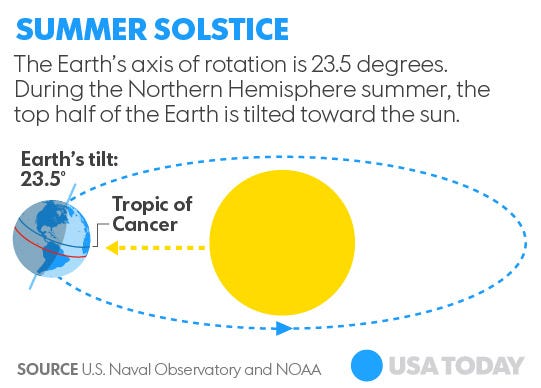
Most of us probably never think of ourselves as being passengers on-board a spinning planet that whips around on its axis of rotation once every 24 hours, or that travels 970 million kilometers on its 365-day journey around the sun. But we are! If the earth’s axis of rotation was perpendicular to the sun-earth line, we would have no solstices and no strong seasonal effects. However, Earth’s rotational axis — the imaginary line through our planet’s center and the geographic north and south poles — isn’t exactly at a right angle to the planet’s orbital path around the sun. Instead, it’s tilted at an angle of about 23.5 degrees from vertical— possibly as the result of a collision with another planet-sized object billions of years ago, when the solar system was forming
Where you live determines how many hours of daylight you receive on the “longest day of the year.” Here in Virginia, we’ll receive 14 hours and 49 minutes minutes of daylight today, on the Summer Solstice.
The summer solstice occurs at the moment in our 365-day year, when that tilt toward the sun is at a maximum. On this day, today, the June solstice, Earth is positioned in its orbit so that our world’s North Pole is leaning most toward the sun. As seen from Earth, the sun is directly overhead at noon 23.5 degrees north of the equator, at an imaginary line encircling the globe known as the Tropic of Cancer– named after the constellation Cancer the Crab.. This is as far north as the sun ever gets. As Earth orbits the sun over the course of each year, its axis always points at the same direction in space. That means the Northern Hemisphere is angled toward the sun for half the year and angled away from the sun for the other half.
“Solstice” is derived from the Latin words “sol” (sun) and “sister” (to make stand). To early astronomers, it literally meant the moment in which they observed the sun “standing still in the sky.” After this date, the days start getting “shorter,” i.e., the length of daylight starts to decrease, and although we now call it our “summer season,” we’re actually headed toward the next seasonal change, the autumnal equinox (September 22nd in 2020), commonly called Fall-when the days and nights have equal amount of daylight and darkness-12 hours.
Ancient cultures knew that the sun’s path across the sky, the length of daylight, and the location of the sunrise and sunset all shifted in a regular way throughout the year. They built monuments, such as Stonehenge, to follow the sun’s yearly progress. Native American tribes of the Bighorn Mountains in present-day Wyoming once constructed stone wheels with 28 spokes in tribute to the Summer Solstice. This “medicine wheel” was aligned with sunrise and sunset on Solstice. Constructed at the top of a mountain range, the structure is only accessible during the summer months. Similar wheels have been found across South Dakota, Montana, and parts of Canada.
Stonehenge, near Wiltshire, England photo courtesy of Enea KeloNative American Medicine Wheel near Lovell, Wyoming photo courtesy of Kathy Whalen
We refer to today as the “longest day of the year,” the day the “sun stands still in the sky.” Enjoy it-Celebrate it! Get Out and About today!
Chincoteague Island is located on the Eastern Shore of
Virginia. The name chincoteague meant
“Beautiful land across the water” in the language of the Native Americans
who lived in the area-primarily the indigenous Assateague people. For visitors to this popular destination, there
still seems to be some confusion of these two names-primarily when it comes to
geography, so let’s try and clarify which is which, and where is where-me
included!
First, they are both part of a chain of sandy barrier islands separating the mainland from the Atlantic Ocean. Assateague Island, on the ocean side, is a 37-mile long and skinny island that extends northward towards Ocean City, Maryland. Most of Assateague Island is protected parkland by the National Park Service’s Assateague Island National Seashore. Chincoteague Island sits immediately west of Assateague’s southern tip, protected from the ocean by Assateague. It rests comfortably within Chincoteague Bay. To add a bit more confusion to the mix, the U.S. Fish and Wildlife Service maintains its Chincoteague National Wildlife Refuge on Assateague Island directly across a short causeway from Chincoteague Island and the town of Chincoteague. Got all that? Assateague is an island. Chincoteague is an island, a town, a bay and a wildlife refuge.
Even so, Chincoteague it still manages to hold onto a
small-town feel unlike its Maryland and Delaware counterparts further up the
Atlantic coast. This can probably be attributed to geographic isolation and
government ownership of its beach. There will never be any commercial
development allowed to build ocean-front hotels, boardwalks or any other
businesses along the ocean waterfront here. The most famous residents, and
attraction to this area, have four legs-the wild ponies.
Cattle Egrets feed with a wild mare and foal pony in Chincoteague NWR
Ponies have occupied Assateague Island since the colonial era
although nobody really knows exactly how or when they arrived. The standing
theory, and one that seems more exciting for tourists, is that they escaped Spanish
galleons that shipwrecked off-shore.
Also
“wild” ponies seem a bit of an exaggeration unless one defines wild
to mean “mellow ponies without saddles.” Take the Assateague ponies
five miles inland, drop them in a large field and nobody would bother to give
them a passing glance. Stick the very same ponies on an island, combine them
with romantic tales of Spanish shipwrecks and an iconic children’s book (Misty of Chincoteague-1947) and
following movie (Misty-1961), then
watch tourists gawk! Nothing has done more to
transform Chincoteague from a fishing village focused on the bounty of the sea
into a tourist destination harvesting travelers more than the renowned Misty
mystique.
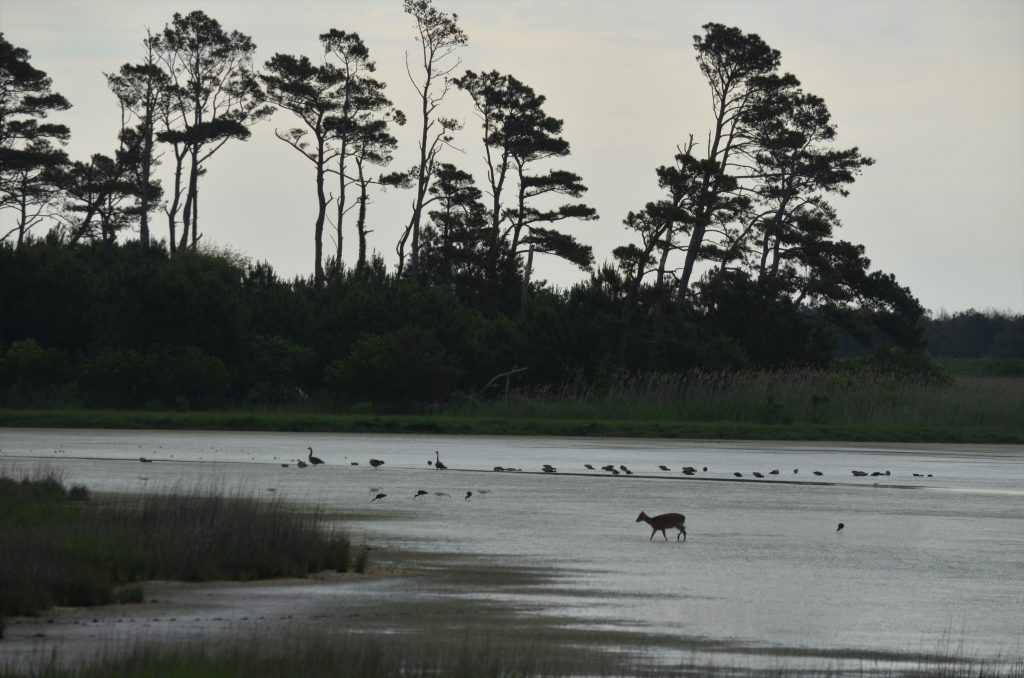
A Sika Deer wanders through a marsh at dawn in Chincoteague NWR
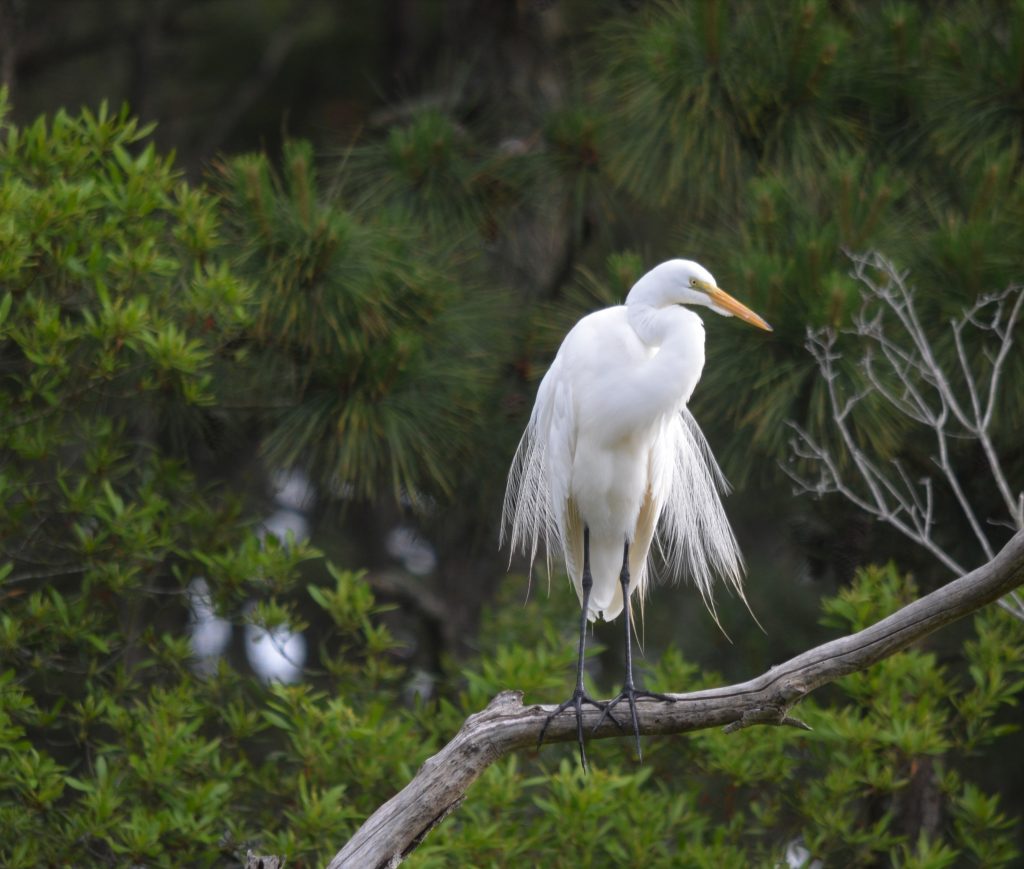
Great Egret
Tricolored Heron
But it’s the natural features of the area-vast beach stretches and coastal salt marshes that attract thousands of migrating and breeding birds-and the reason I visit the Chincoteague-Assateague area as well. However, you must be patient, since there can be crowds of people coming to see the “wild ponies” and visiting the recreation beach. Even though it was fairly busy with people (there’s only one road in and out) the last weekend in May when I visited, I still managed to see 103 different species of birds-not too bad for trying to social distance from everyone else!
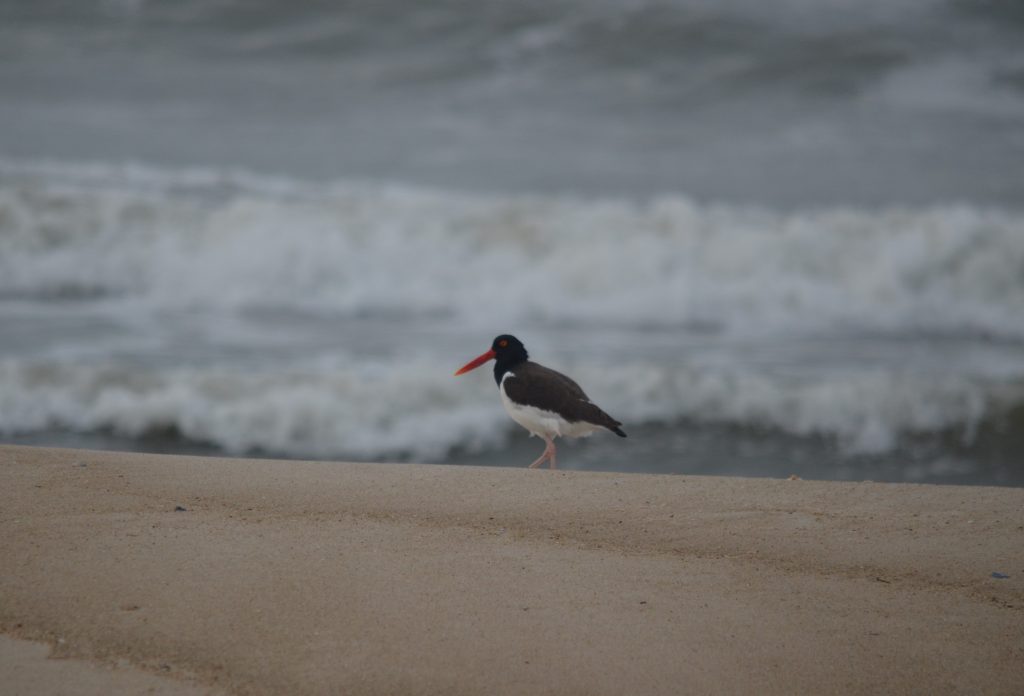
American Oystercatcher
Clapper Rail
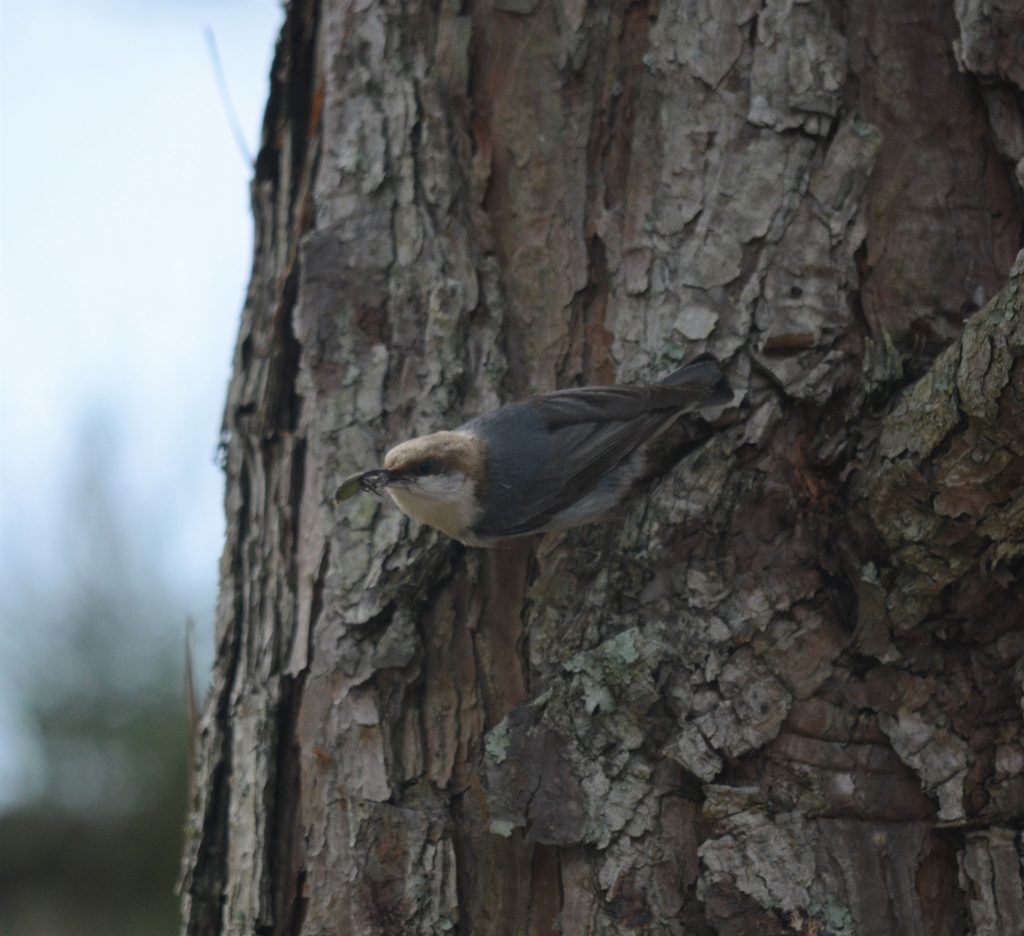
Brown-headed Nuthatch
White Ibises (l) and Glossy Ibis (r)
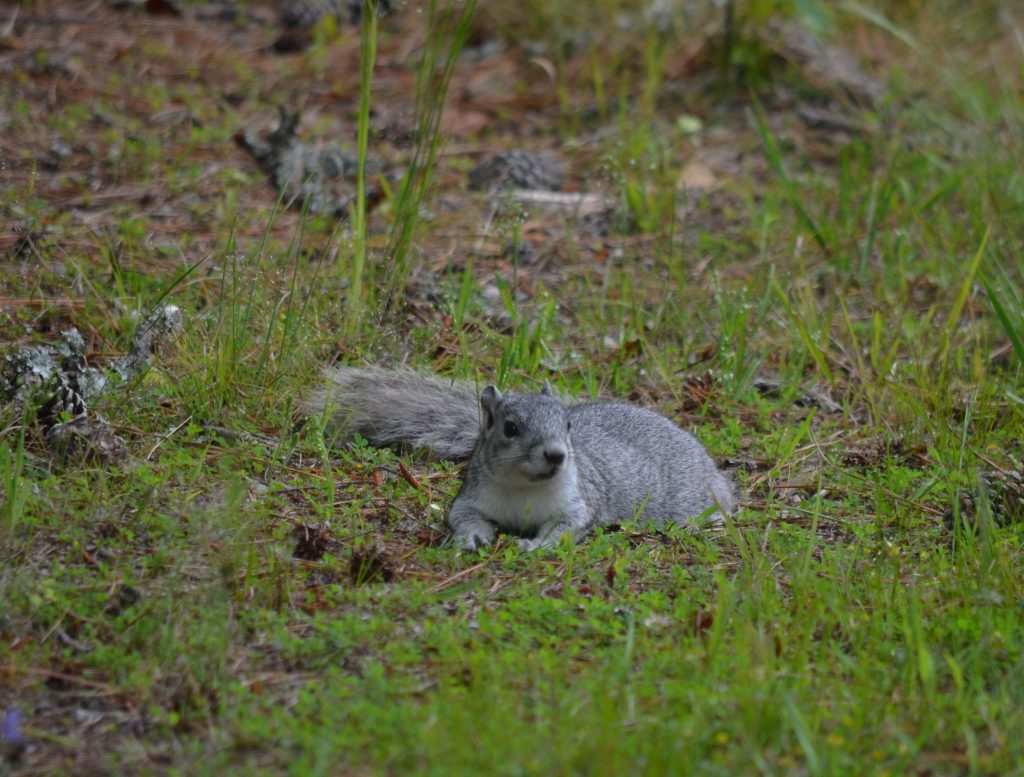
Endangered Delmarva Fox Squirrel hanging out in the refuge
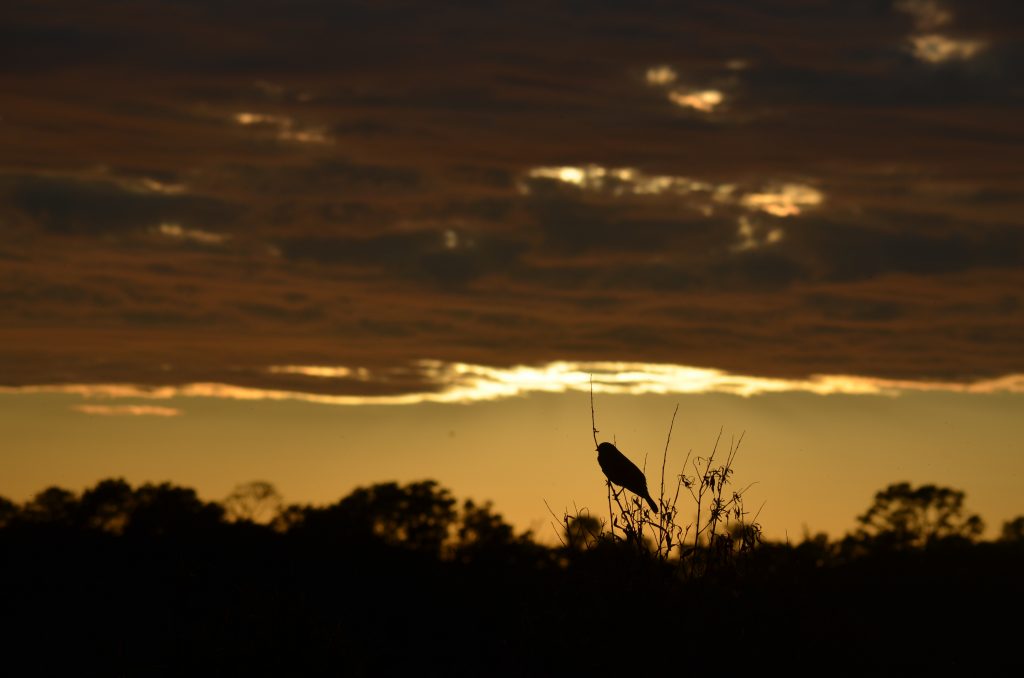
A Red-winged Blackbird watches over a marsh at sunset in Chincoteague NWR
One of my favorite groups
of birds in North America is the grosbeaks. These robust, colorful, and
sometimes, very musical birds, can be found from the west coast to the east
coast, and from Canada to Mexico. Specific species may use a variety of
habitats during breeding and migration. Common members include Rose-breasted Grosbeak,
Evening Grosbeak, Blue Grosbeak, Black-headed Grosbeak, Pine Grosbeak and two
Mexican species that rarely wander north into the southern U.S.-the Yellow Grosbeak
and Crimson-collared Grosbeak.
A male Rose-breasted Grosbeak pauses on a warm spring morning
GROSBEAKS get their name from the
French grosbec,
from “gros”
meaning thick and
“bec”
meaning beak.
The beaks of these birds are adapted to
eating seeds, including those of trees such as elms, as well as buds and
flowers. In addition, they also eat a variety of insects, including beetles,
caterpillars, grasshoppers and many others-spiders and snails are also a part
of their diet. In the late summer and fall they may feed heavily on berries and
small fruits. Young are fed mostly insects.
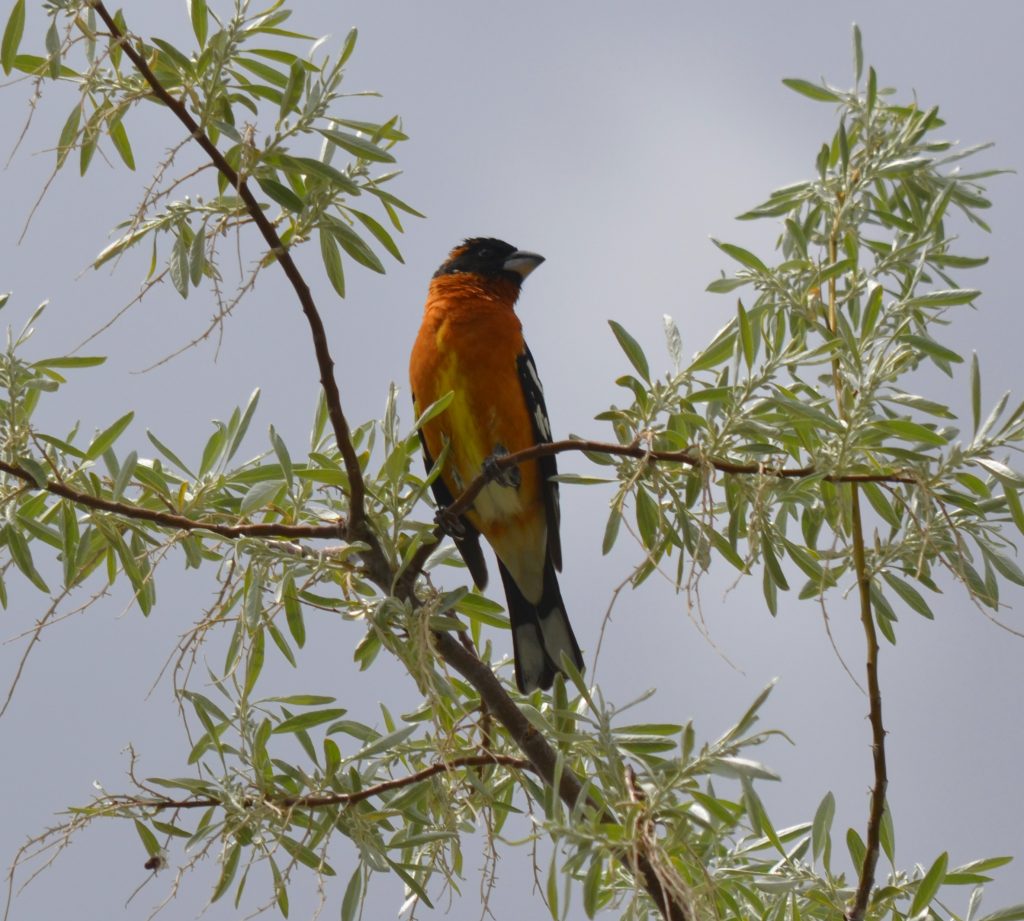
Pine Grosbeak (l), Blue Grosbeak (r), Black-headed Grosbeak (below)
The most common breeding species where I live is the Rose-breasted
Grosbeak. The males are a striking black and white color with a splash of red
on their chest, usually in a V-shape. One gruesome folk nickname of this bird
is “cutthroat.” The females are brown streaked with faint yellow wing linings.
They’re usually found in deciduous forests, old fields and overgrown orchards.
But as fall gives way to winter, another grosbeak may make a rare appearance!
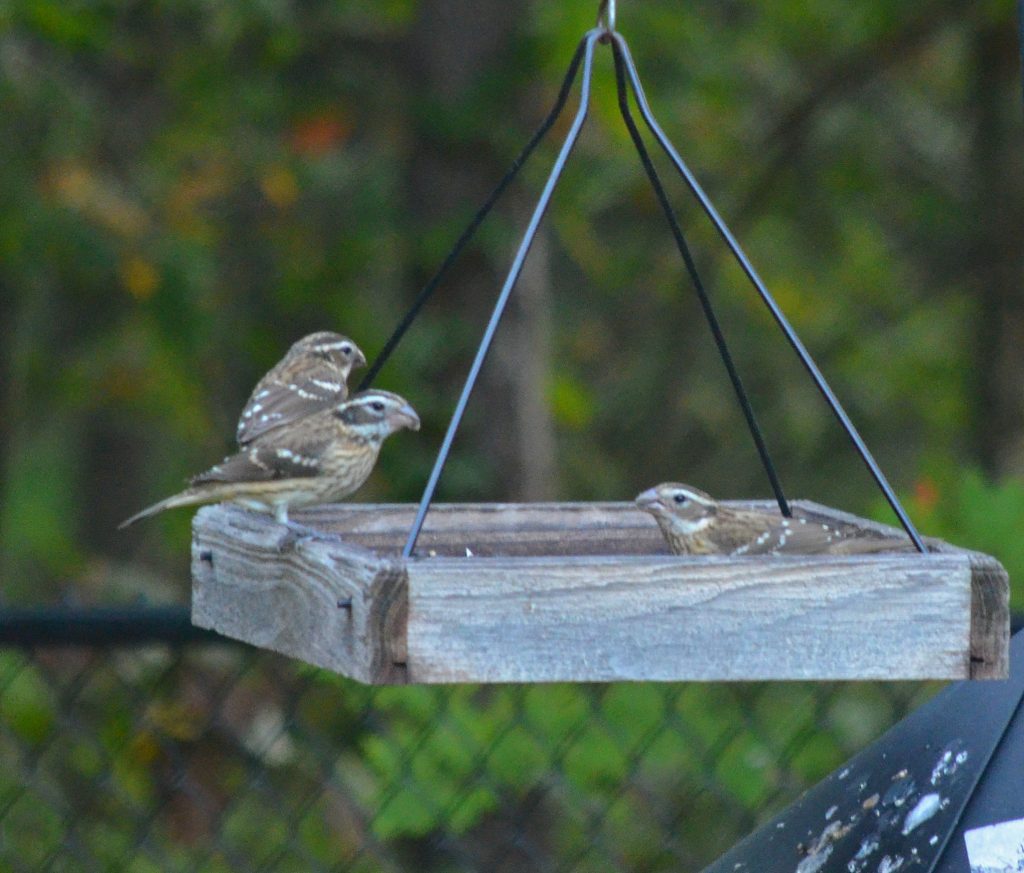
Female Rose-breasted Grosbeaks (l) feed on sunflower seeds and a male sings in the morning sunlight (r)
Every winter I wait patiently, hoping to be invaded by
one of the coolest of its kind, the Evening Grosbeak! Here in the east, these
seed-eating machines will infrequently venture south from Canada in search of
food, raiding backyard bird feeders like small swarms of locust. The males’
handsome gold, black and white markings make them one of the most popular
winter time birds!
Male Evening Grosbeak photo courtesy of Linnae Halvorsen Photography
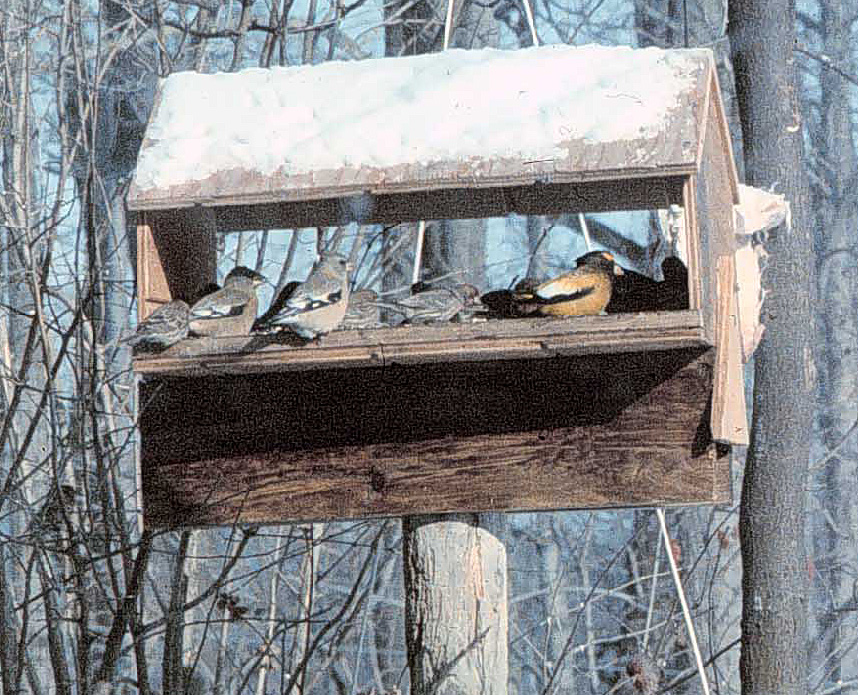
When I was kid growing up in NE Pennsylvania in the
1970’s and early 80’s, every winter we would have hordes of Evening Grosbeaks
drop in to gorge on our sunflower seeds. It wouldn’t be unusual to have flocks
of 50+ drop in unexpected, feed ravenously, then quickly disappear. Unfortunately, in the last 20 years the population
of Evening Grosbeaks has been declining throughout their range. Scientists
believe the main reasons for their decline is due to habitat loss in their
northern breeding forests and pesticides used to control spruce budworm, an
important food source for them, and other northern bird species.
A flock of Evening Grosbeaks crowds into our Pennsylvania feeder, in this photo from 1980.
My birding year, and outdoor adventures, would not be
complete if I didn’t get a chance to see at least one Grosbeak, every
year…….and maybe, just maybe, when the cold winds blow down from Canada, I may
get another look at those eye-catching winter visitors from the north! Enjoy
the Outdoors!
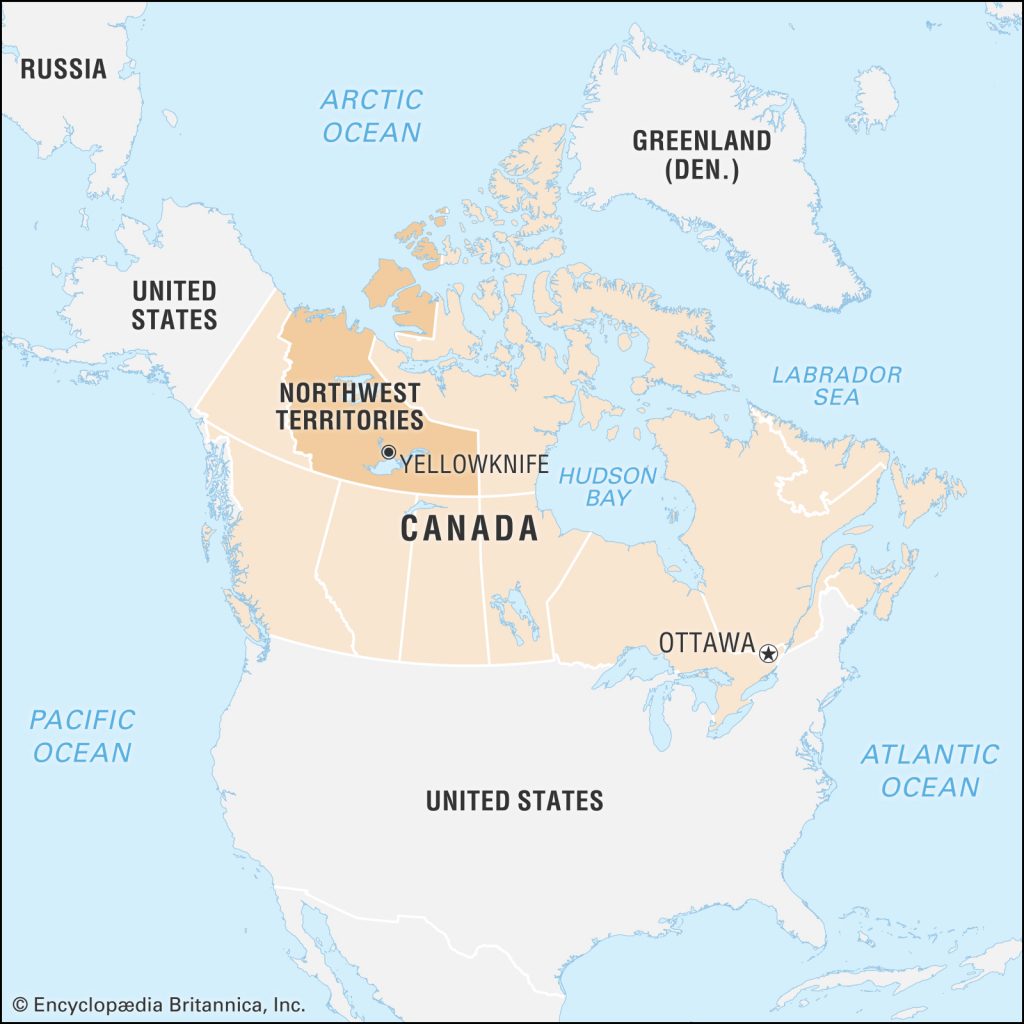
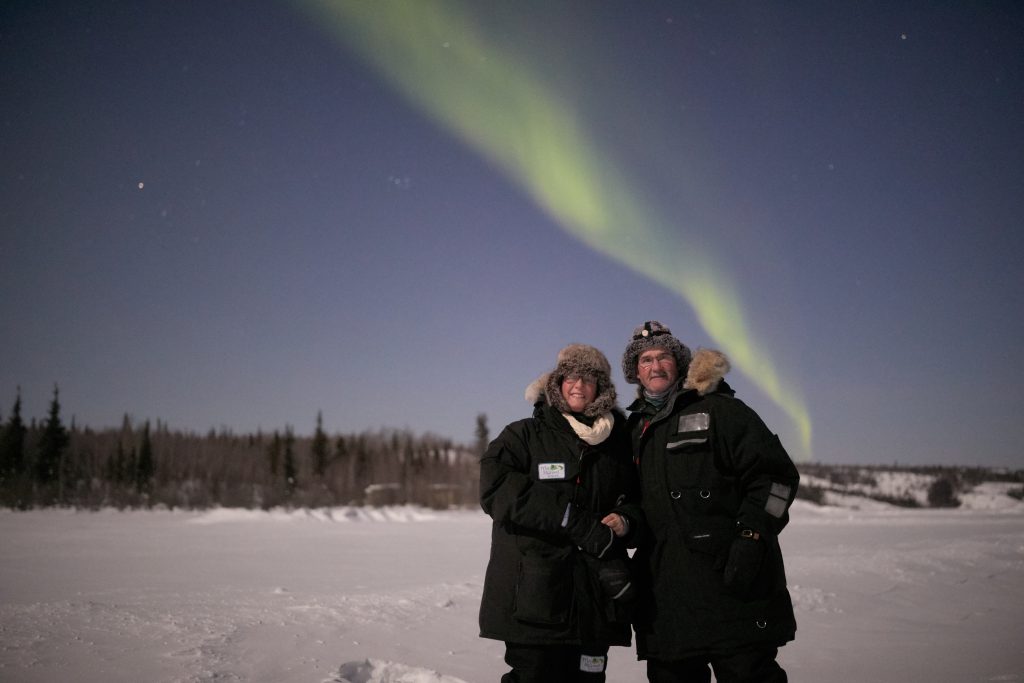
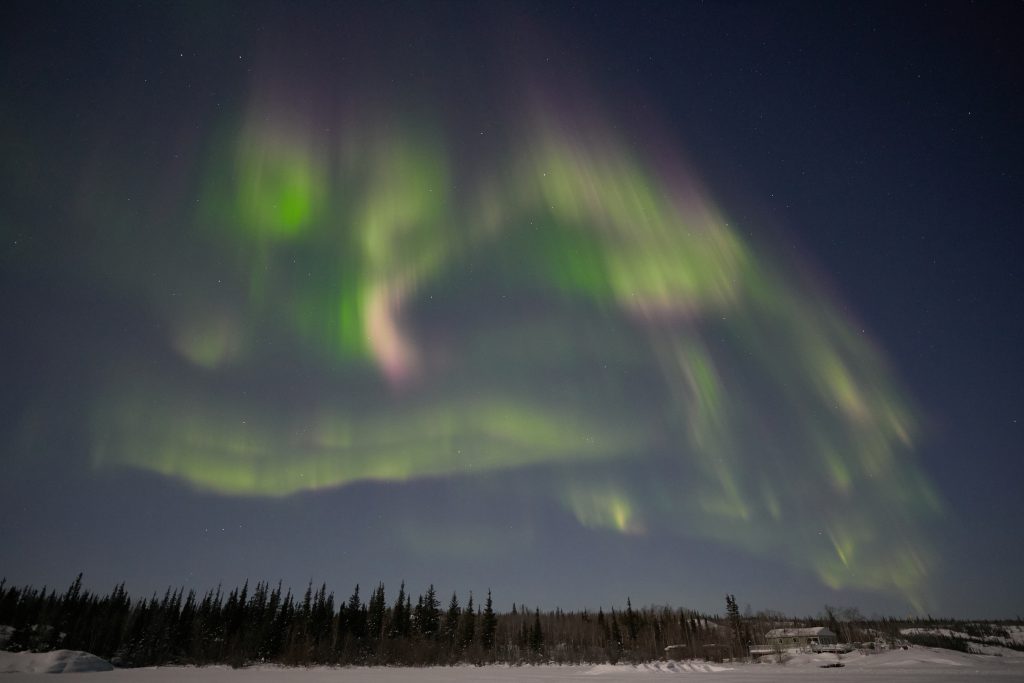
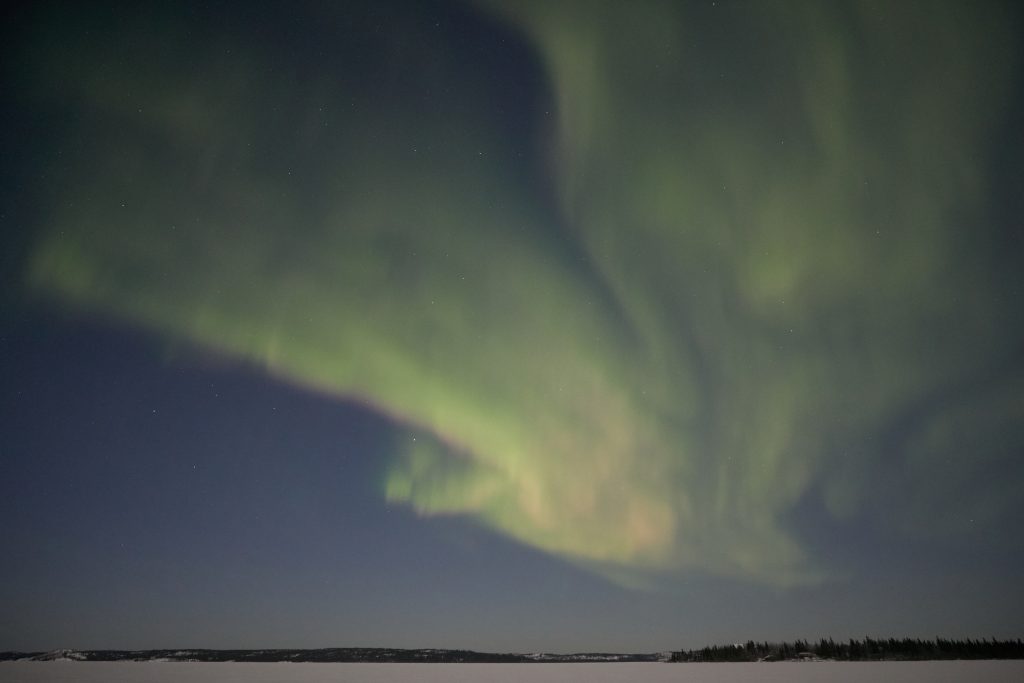
We stood there motionless on a frozen lake just north of Yellowknife, Northwest Territories in Canada’s far north. Our eyes gazed upward at the waves of green, pink and white that danced and rolled across the moonlit and star-filled night sky. As quickly as the illuminations disappeared from the horizon in front of us, they would appear directly over our heads, or ripple behind us, or sometimes both! The air temperature was -23°F (-30°C), and with each warm breath we exhaled, the moisture on our fogged-up glasses quickly formed ice crystals. I wiped off the cold, pulled back the sleeve of my goose down parka and looked at my watch. It was 12:30 am. I’m not sure why I cared about knowing what time it was at that particular moment, but for some reason I simply wanted to make a mental note of the exact time we first experienced the Aurora borealis, also known as the Northern Lights. I use the word “experienced” because it was more than just “seeing” them. It was being there-together, in that environment, at that exact time. But even as we both managed to snap a few really beautiful photos with cold, draining batteries, there were many moments that we put the cameras and phones away and watched in pure amazement! You couldn’t help it, and you just wanted “the show” to continue all night!
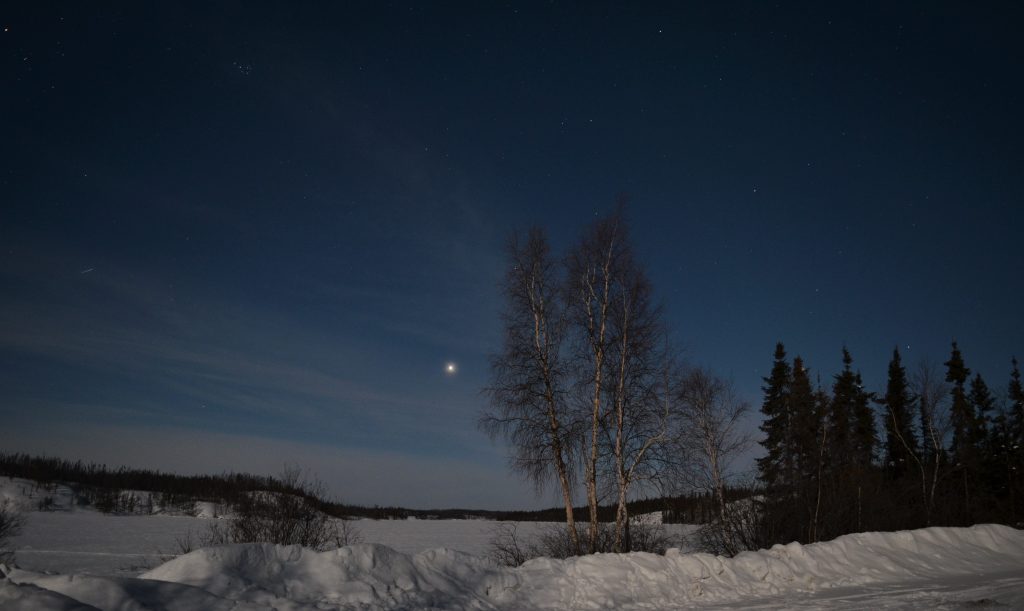
As we waited for the Aurora to begin, we enjoyed a beautiful, but frigid night…..as Venus was about to set in the western sky.
Experiencing this long-awaited bucket list item included many months of planning as to where, when and how to go. Should we hire a guide, go with a pre-arranged tour, or go it alone. In the end, we decided to go with one-man tour company (www.seannorman.com), the “Aurora Chaser,” and it was the best decision we made! Sean enthusiastically shared his passion and knowledge of how this natural phenomenon occurs, and why. Listening to his personal stories and connections to nature and the native culture, it was easy to get excited about his appetite (and addiction) to viewing the Aurora!
As we learned, the Northern Lights are actually the result of collisions between gaseous particles in the Earth’s atmosphere with charged particles released from the sun’s atmosphere. The lights are seen above the magnetic poles of the northern and southern hemispheres. They are known as ‘Aurora borealis’ in the north and ‘Aurora australis’ in the south. It can happen in a variety of eerie colors, including green, blue, white, pink, and in rarer instances, red and purple. Sean told us in that you can view them in Yellowknife from August through April, but you must have clear skies.
Theresa-Inside
Theresa-Outside
Our adventure to the Great White North was not limited to just the wonderful nightly display of the Aurora. Yellowknife had much more to offer during our visit to this frozen destination in March. We also explored some of the remote territorial parks in search of a few of the native birds and other wildlife.
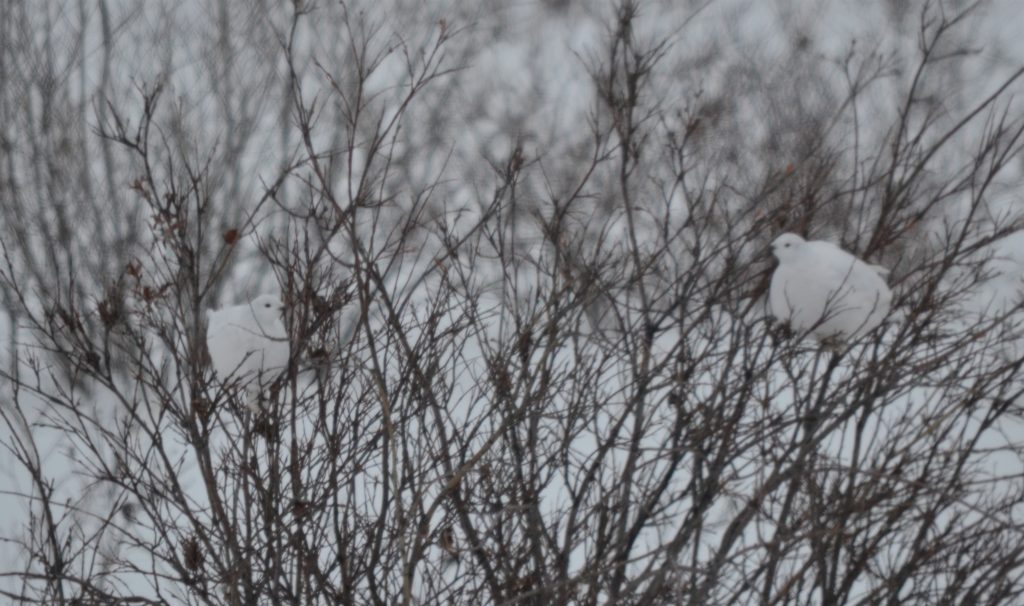
Looking like balls of snow in a bush, the winter plumage of these 2 Willow Ptarmigan makes them perfectly camouflaged.
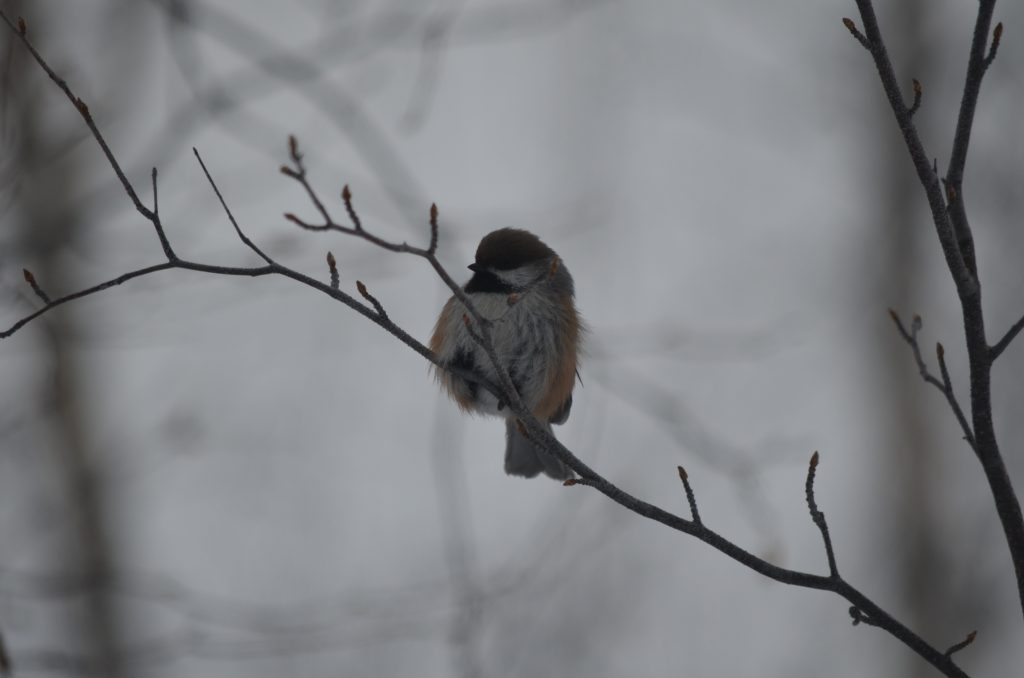
A Boreal chickadee tries stay warm on a very cold morning.
A River Otter rests after catching a small fish near Hibbitt Lake
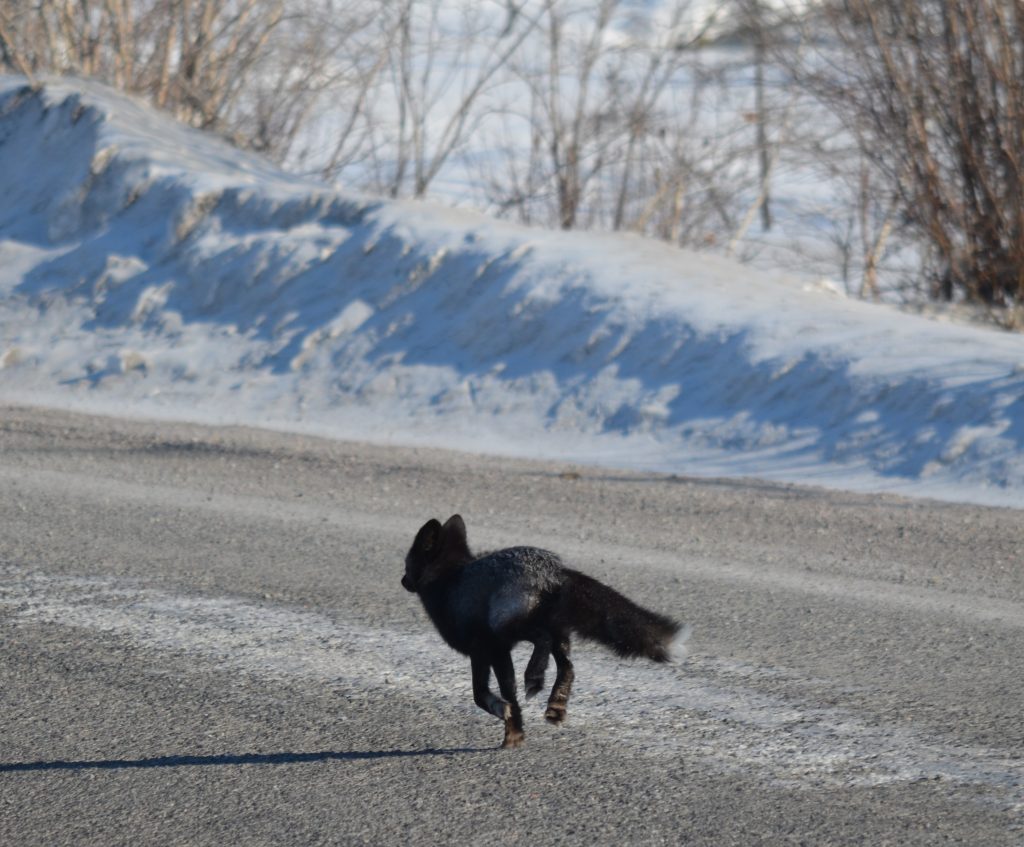
A Red Fox (silver phase) trots on by us, along the Ingraham Trail.
….somewhere north of Yellowknife
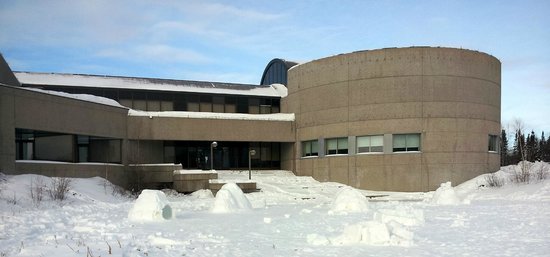
We learned about the history of the region, the animals that live in the boreal forest and the rich culture of the indigenous Dene people at the Prince of Wales Northern Heritage Centre.
Prince of Wales Northern Heritage Centre
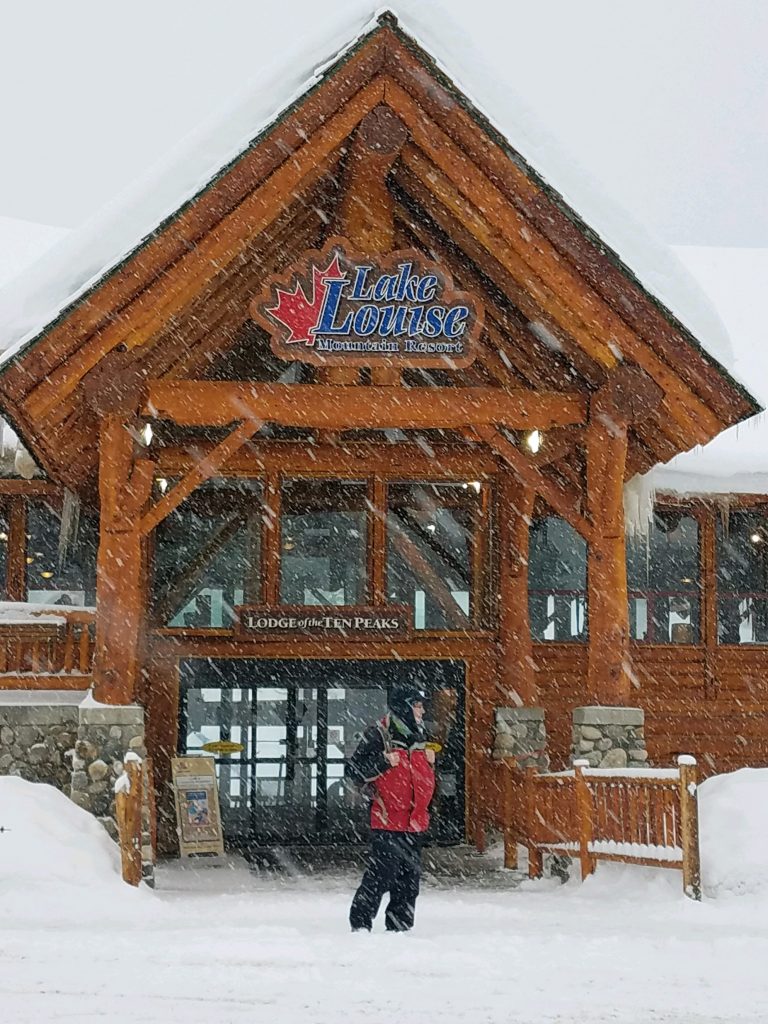
Our travels found us driving down the Dettah Ice Road on Great Slave Lake and we discovered the annual Snow King Ice Castle Festival. In between, we enjoyed the local food and met some great people! As cold as the temps were, Yellowknife was warm and welcoming! We stuffed a lot into our 5 days in Canada, which also included a quick side trip from Calgary, Alberta to Lake Louise in Banff National Park, to take in a little snowshoeing in the Canadian Rockies.
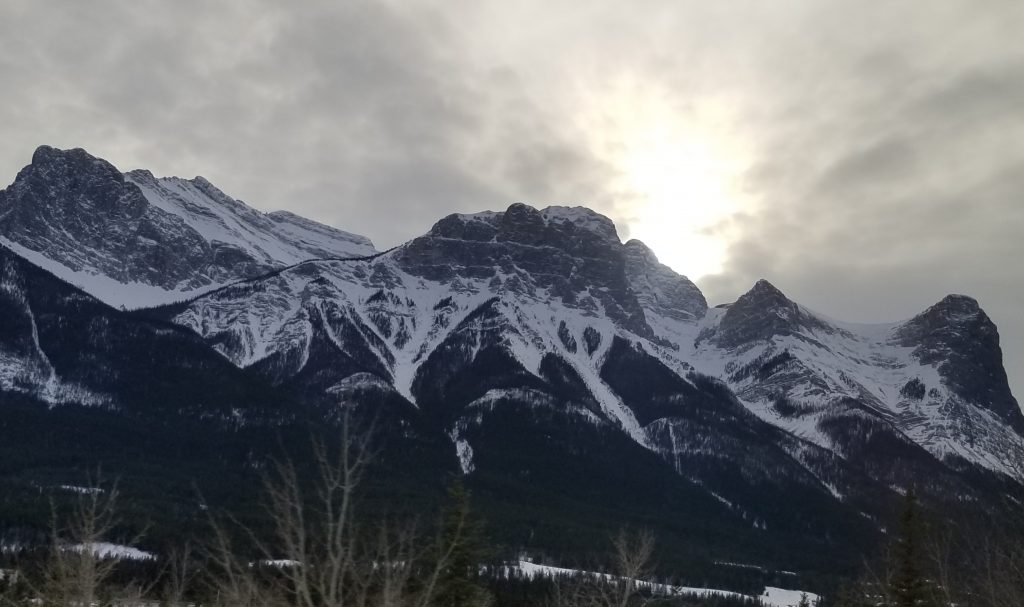
Banff National Park in Alberta
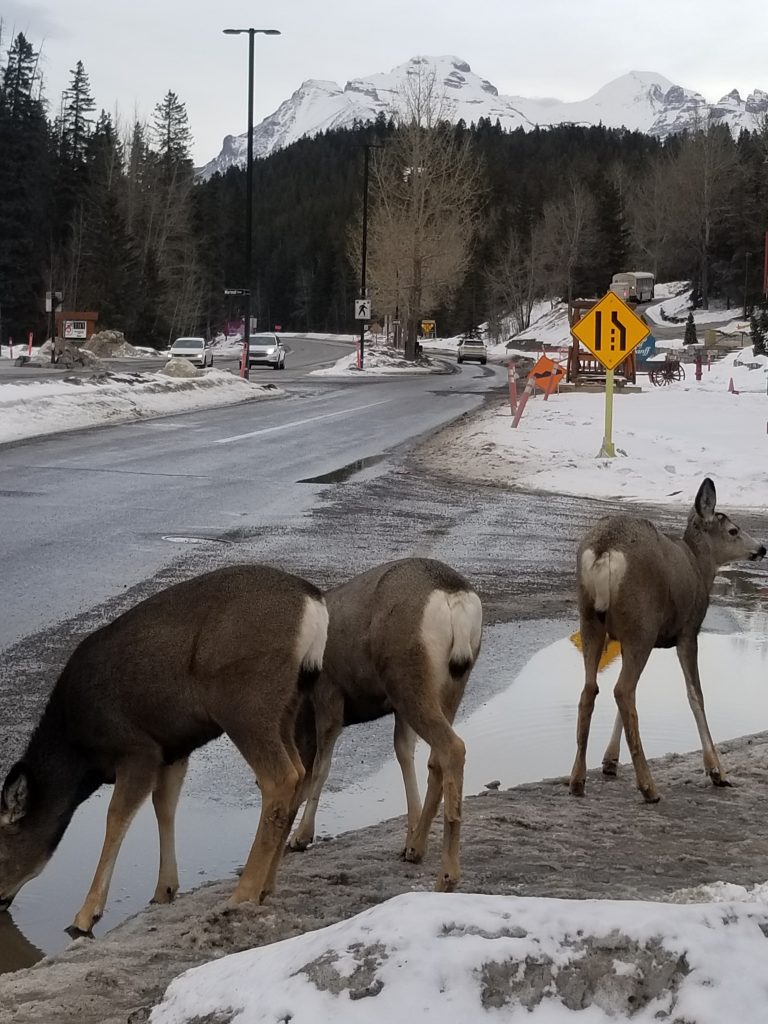
Mule Deer wander into the town of Banff for a quick drink from street puddle.
Our packed schedule was a bit hectic at times, but mostly it was a fun, fantastic trip with memories we’ll have for a lifetime……and oh, those lights, those beautiful Northern Lights! Cheers!
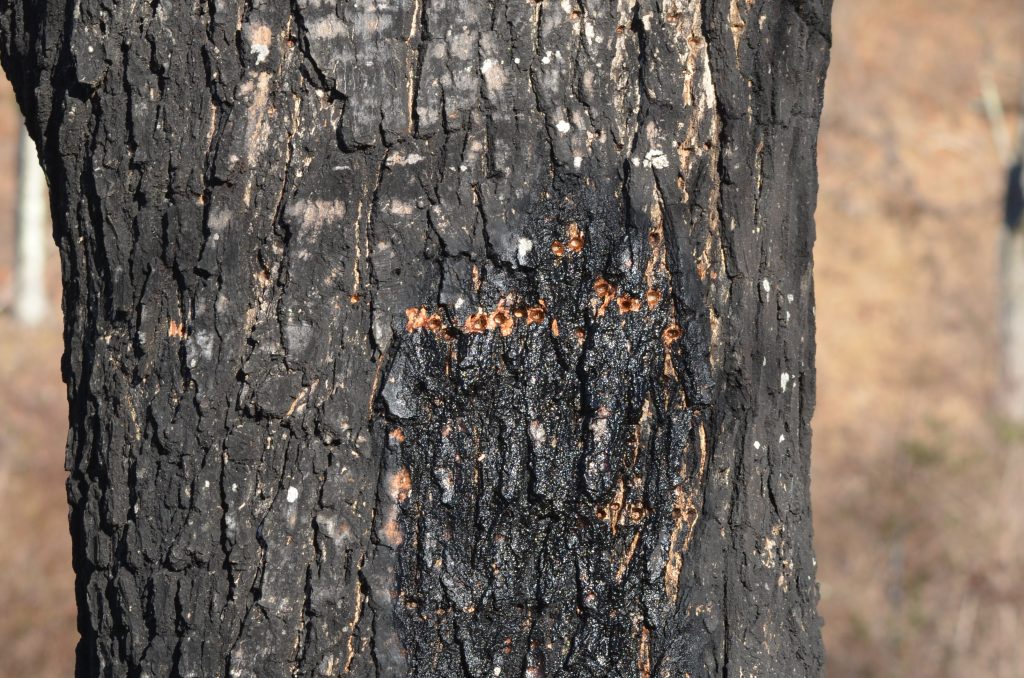
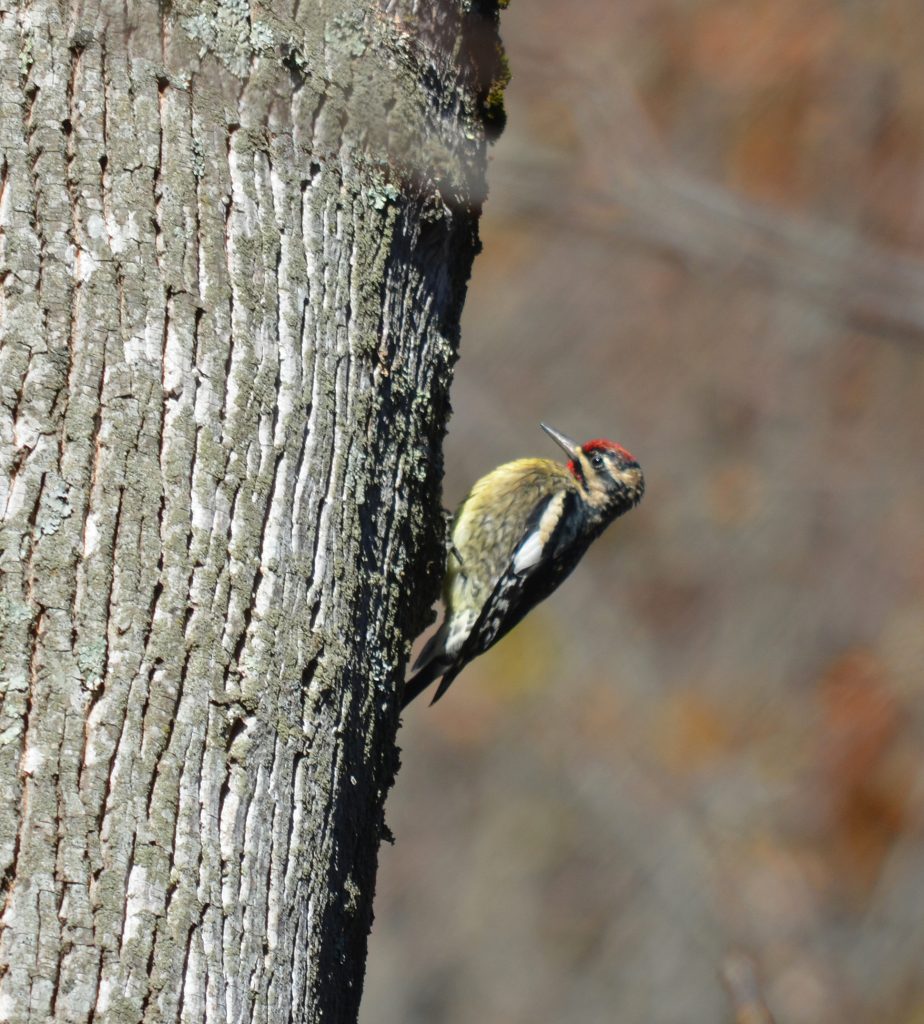
I discovered the main clue the critter left behind. I had seen these mysterious small holes before. Horizontal rows of small cavities, called sapwells, drilled into the trunk of a Sugar Maple tree. They were so fresh that sap from the tree was still trickling out of each hole, still wet to the touch. The animal had just been here, and was most likely close by, waiting to return to lap up its reward. It was a type of woodpecker with an appropriate name-the Yellow-bellied Sapsucker.
Sap runs from a row of horizontal holes, called sapwells, drilled by a Yellow-bellied Sapsucker
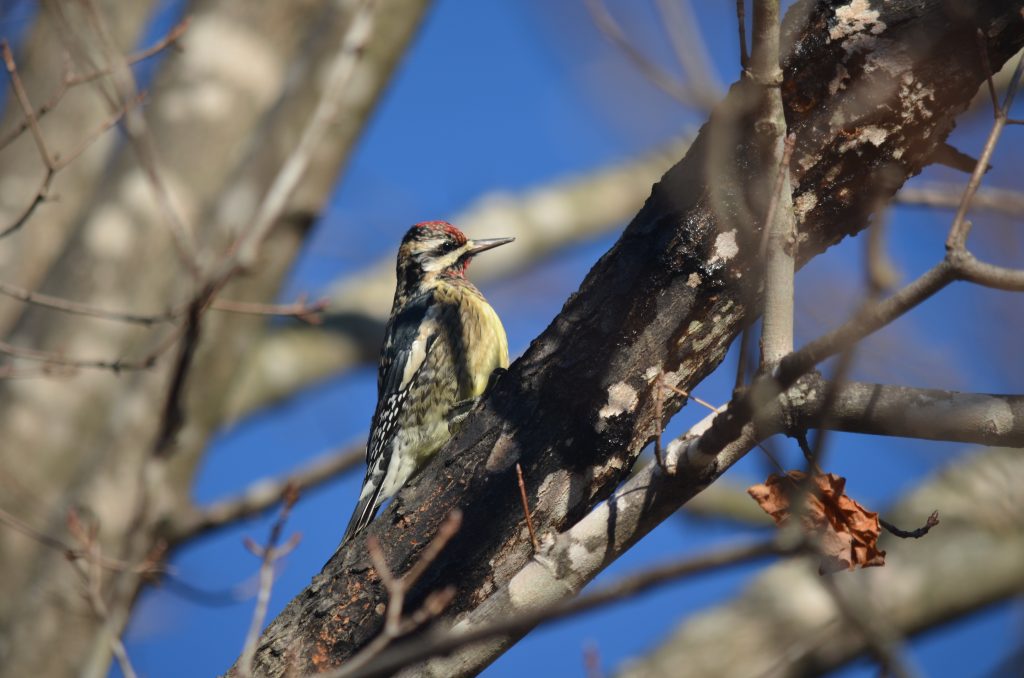
The Yellow-bellied Sapsucker can be identified by its large bill and light yellow belly. Males have a red throat and crown, with black and white facial markings. The wings are dark with large white wing patches.
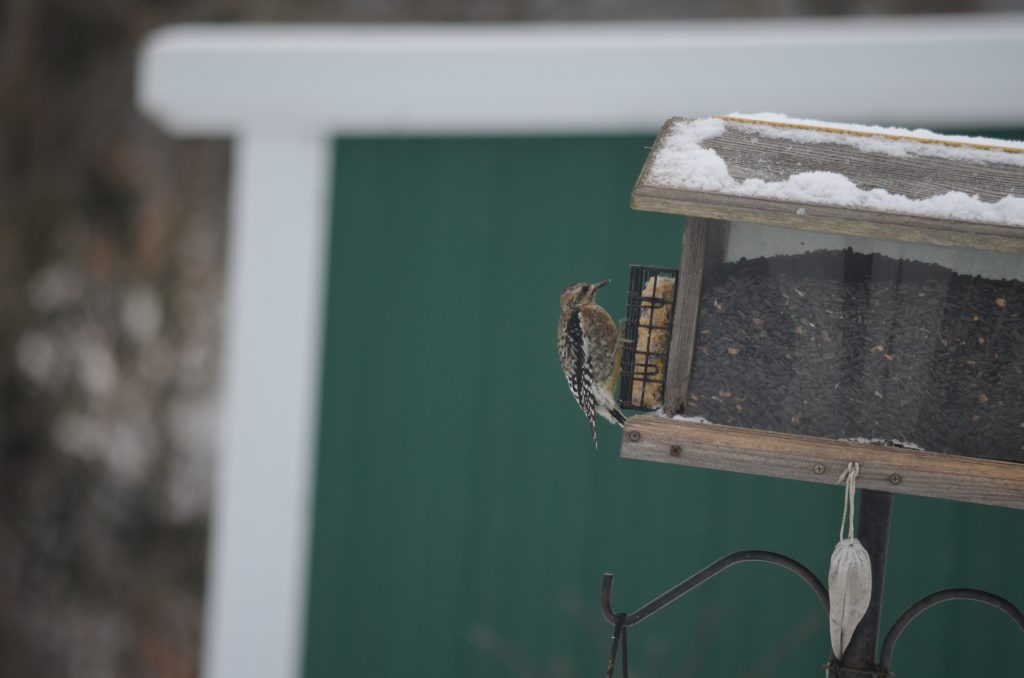
This robin-sized bird’s behavior of tapping into trees is like any other woodpecker. But its attraction to sucking up the oozing sap with its specialized, brush-tipped tongue is a bit unique in the bird world. The sap also attracts insects, which the sapsucker will gladly dine on along with the flowing, sweet liquid. In winter, they may feed on any leftover berries or fruits. Occasionally in the winter, we’ve had them visit our backyard bird feeding area, pecking away at the suet.
Sporting its duller, winter plumage, a Yellow-bellied Sapsucker visits my sister’s suet feeder.
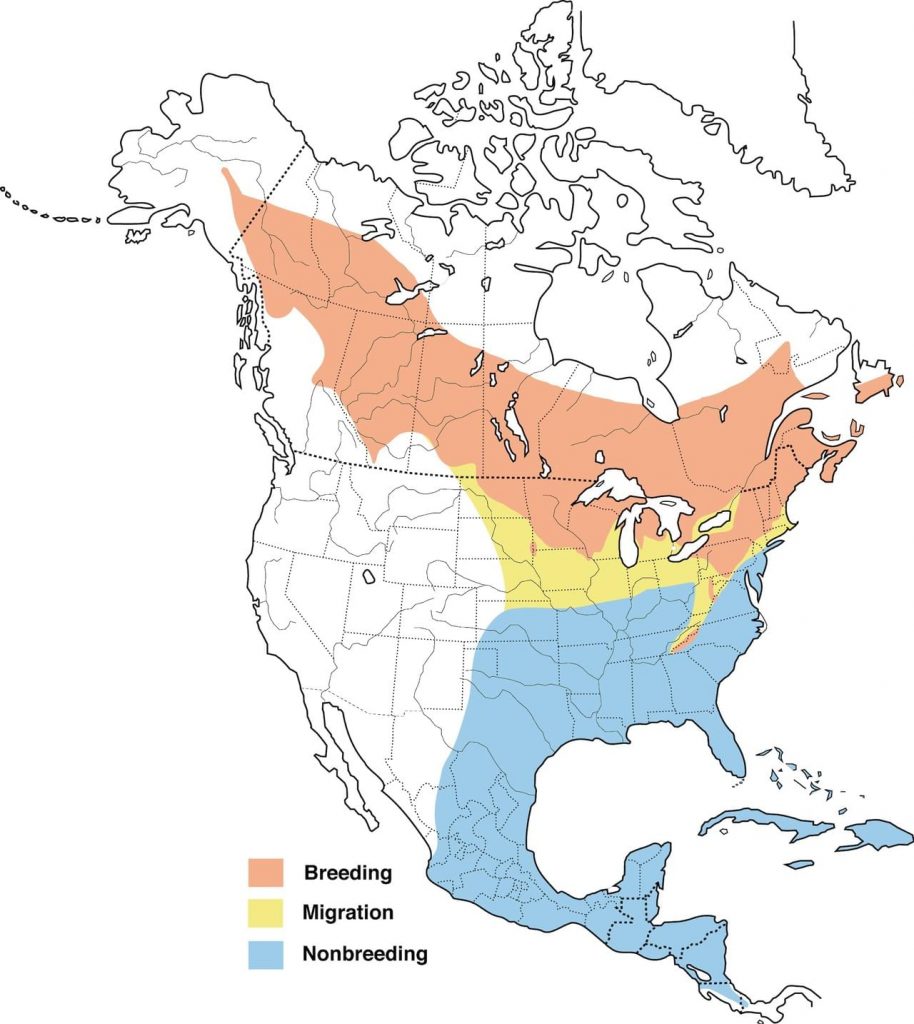
In the U.S. and Canada, there are four sapsucker species that occur-the Yellow-bellied, Red-breasted, Red-naped and Williamson’s. Only the Yellow-bellied can be found regularly in the east. The other 3 inhabit the western part of the country. They prefer mixed deciduous-coniferous forests, but can also be found in parks and backyard woodlots. Common trees they visit include maple, birch, aspen, poplar and several fruit trees, like apple trees.
Range of the Yellow-bellied Sapsucker Source: All About Birds (Cornell Lab of Ornithology)
Sapsuckers are one of my favs! I always enjoy seeing these cool-looking birds and hearing their cat like calls each spring. The next time you’re out and about in the forest, look for the distinctive sapwells of the Yellow-bellied Sapsucker! Enjoy!
Energetically
Curious. That’s how I would best describe one of my favorite songbirds-the
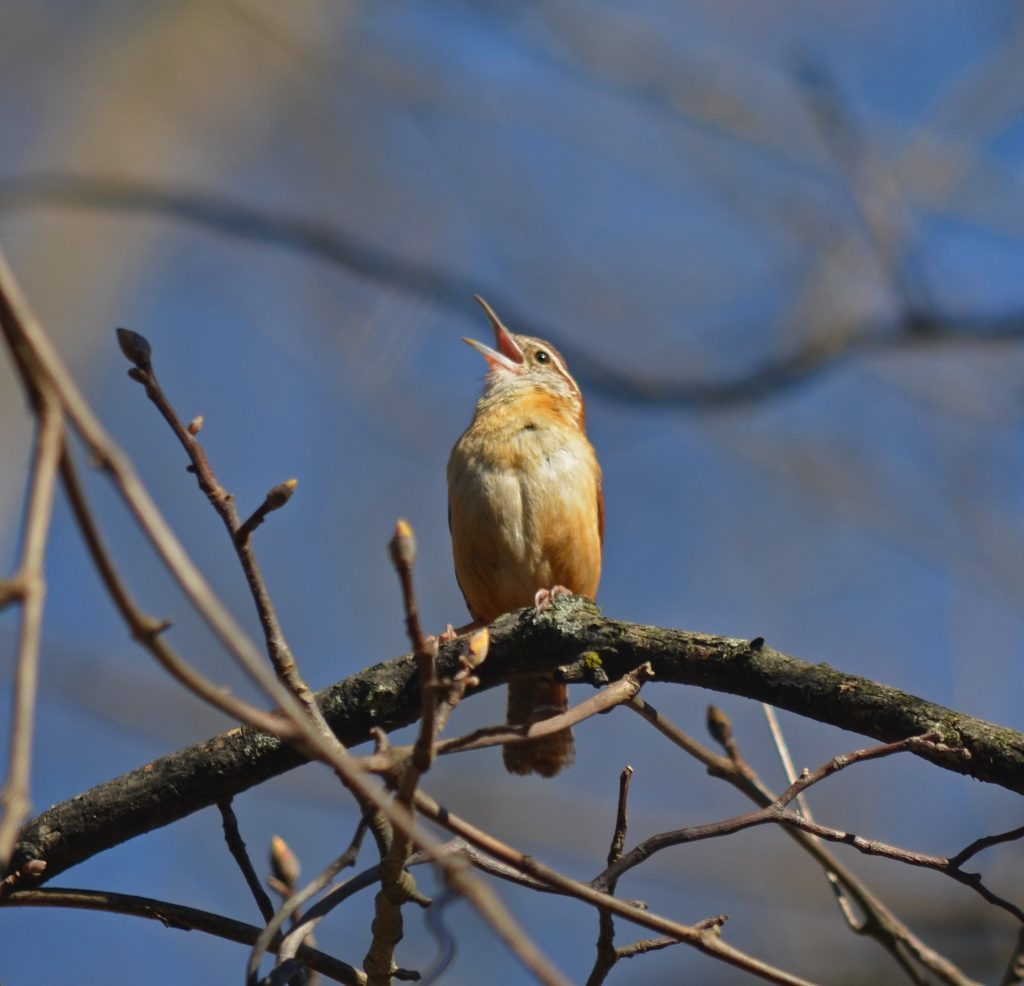
Carolina Wren. These cinnamon-colored wrens with a long, white eyebrow are
common year-round residents in the East. They can be found in a variety of
habitats, including woodlots, backyards, parks and even wetlands, but always
near, or in, thick brush. Growing up in Pennsylvania, these were very uncommon
birds, and difficult to find. But, over the years the Carolina Wren’s range has
steadily expanded north, especially with more mild winters.
One of the
coolest things I like about this active, little bird is its constant curiosity.
It seems as if no nook or cranny is off limits, as it searches for small
insects and fruit. At our home in Virginia, they dart around our back deck,
woodpile and shed. They pick suet from the feeders and take baths in the water
that collects on the picnic table. Their snooping has even brought them into
our house through a back door or garage door that’s been left open. Even at my
workplace, there’s a pair that somehow find their way into our small shop,
hopping around the rafters, along the floor and in and out of the shelves.
Don’t get me wrong, I’m pleasantly surprised to see them, but it’s sometimes a
bit challenging getting them out!
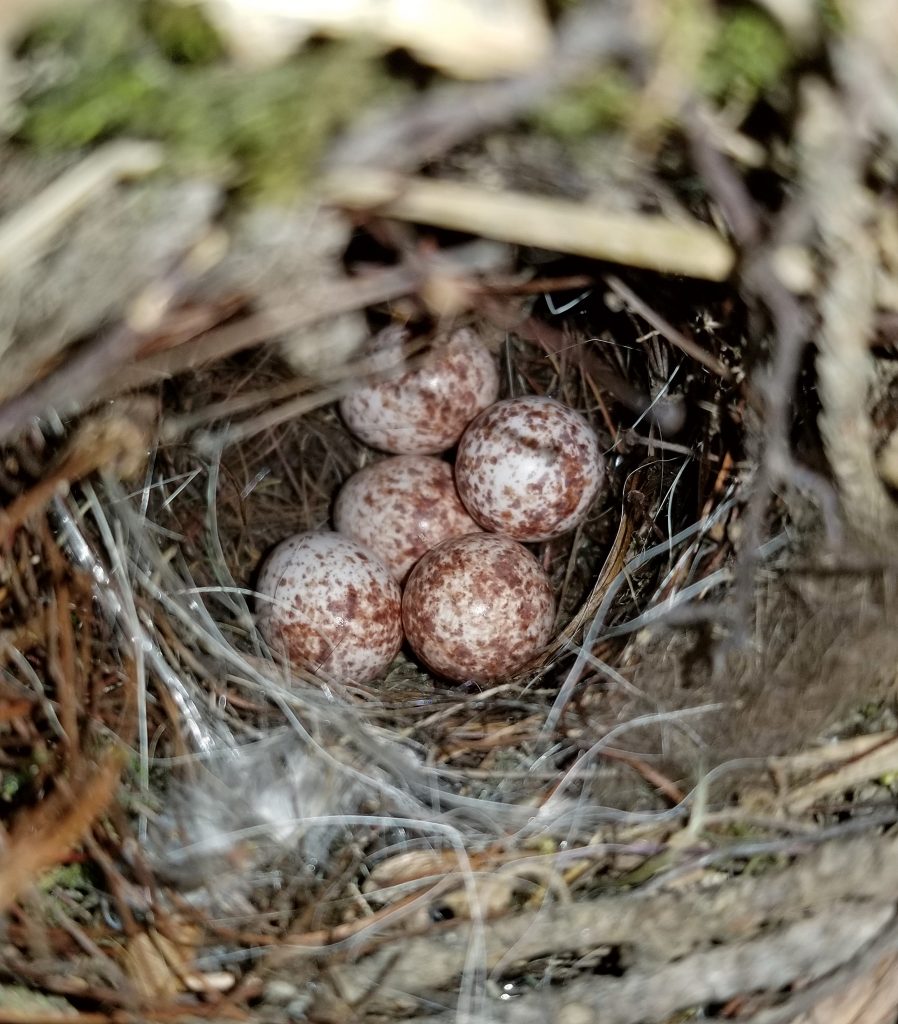
The nest and eggs of a Carolina Wren
Another feature of the Carolina Wren I enjoy is their song. Although they may have several variations, one of their common vocalizations is a 2-syllable song described as “cheery, cheery, cheery, cheery, cheery.” (click below to hear the song of the Carolina Wren) Sometimes, their song changes to a 3-syllable verse, described as “tea-kett-le, tea-kett-le, tea-kett-le.”
They’re also one of the few songbirds that will sing all year-round. I’m lucky to have a job that allows me to work in the great outdoors, and it’s refreshing to come in on a cold, dreary winter day and see a robust little, brown bird sitting on the fence loudly ringing its loud, bubbly song. Sing on Sweet Carolina Wren, sing on!