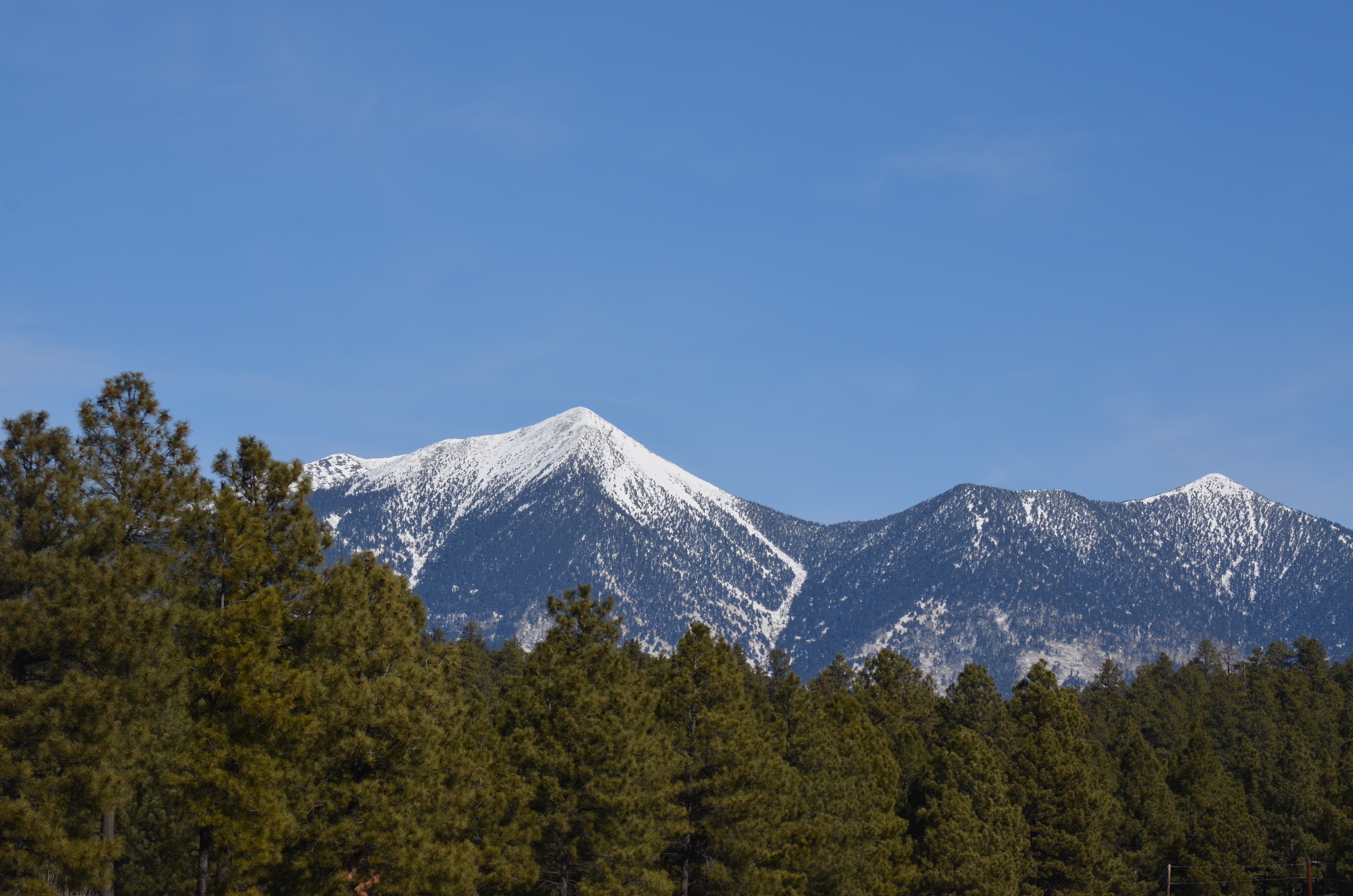
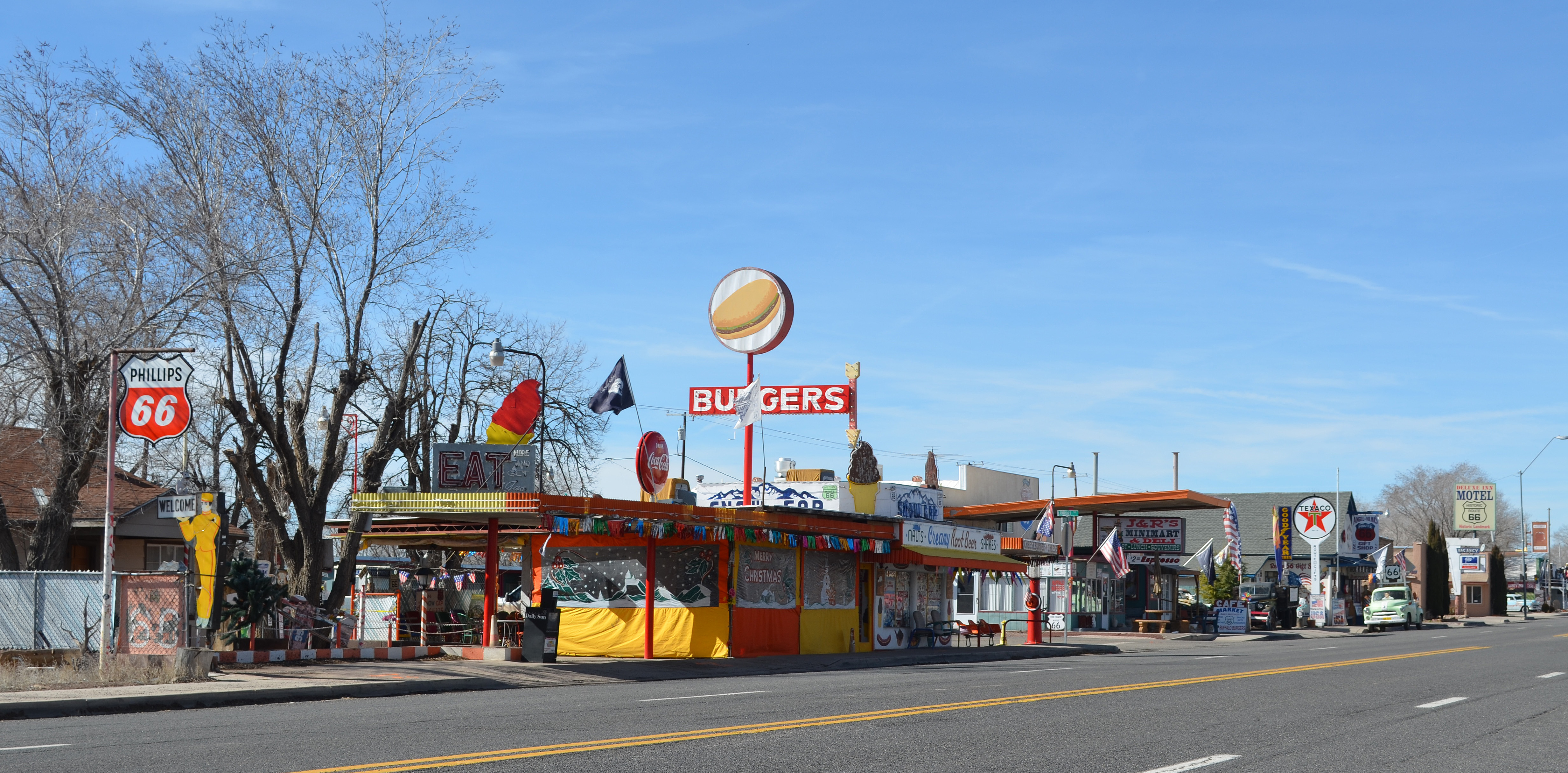
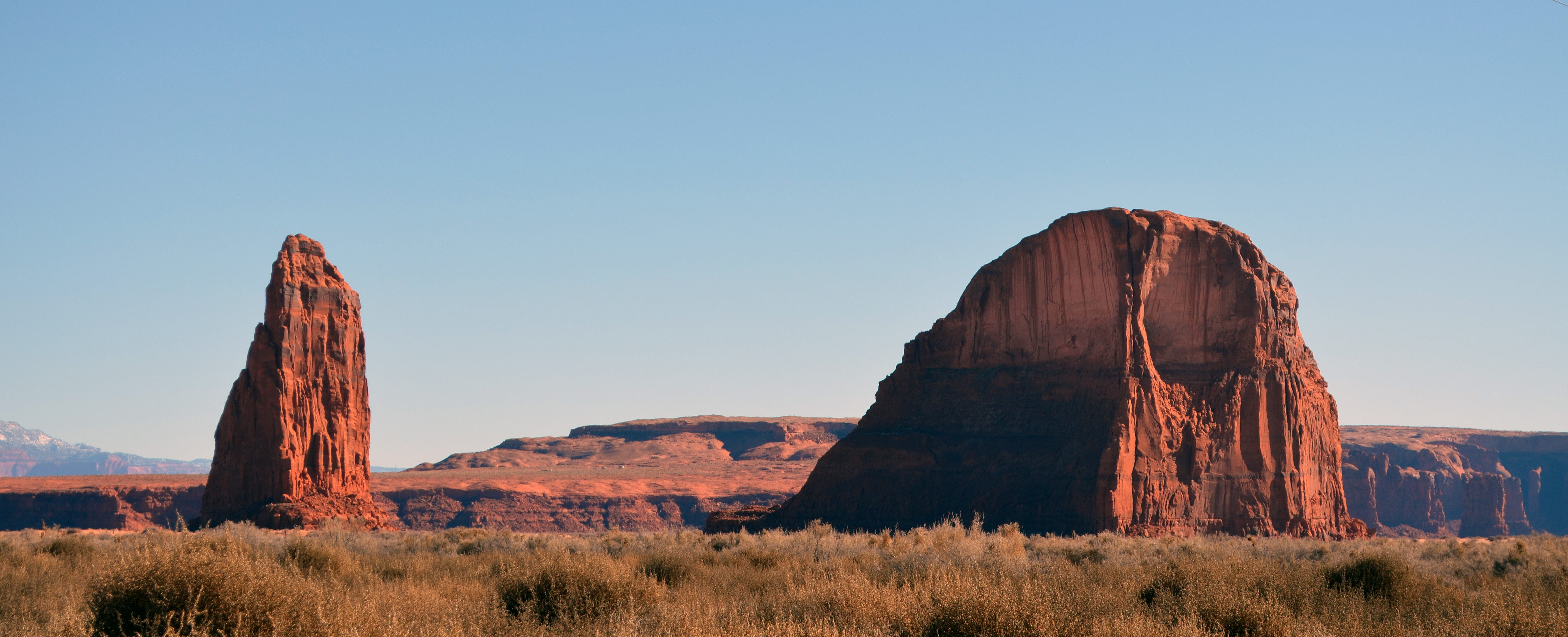
If today had a theme it would be Changing Landscapes. Our trek took us across northern New Mexico and northern Arizona, and through some of the most rugged, but beautiful, terrain imaginable. There’s at least a dozen adjectives I could use to describe some of the places we traveled through, but the ones that pop in mind are wild, rugged, majestic and even serene.
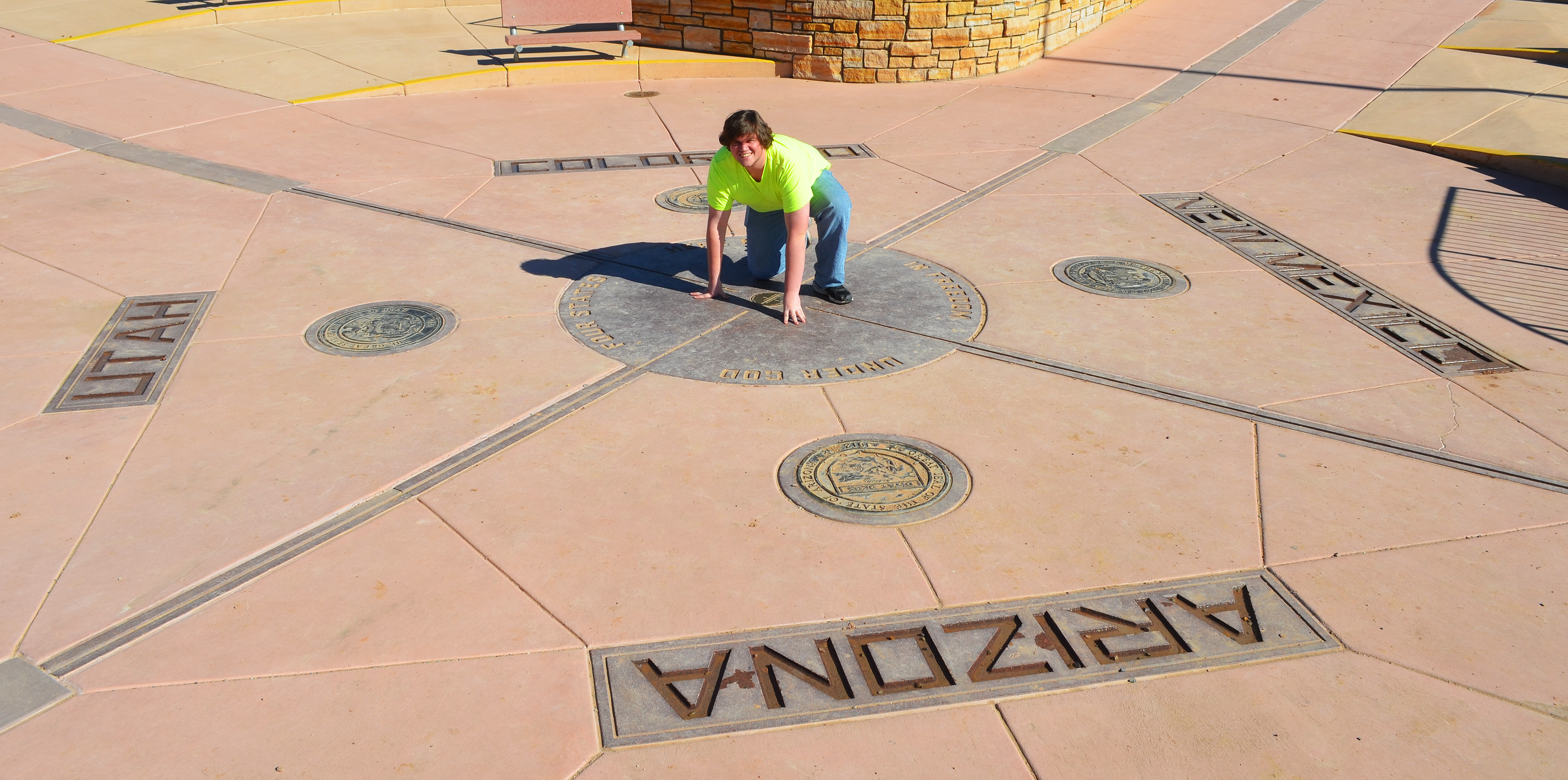
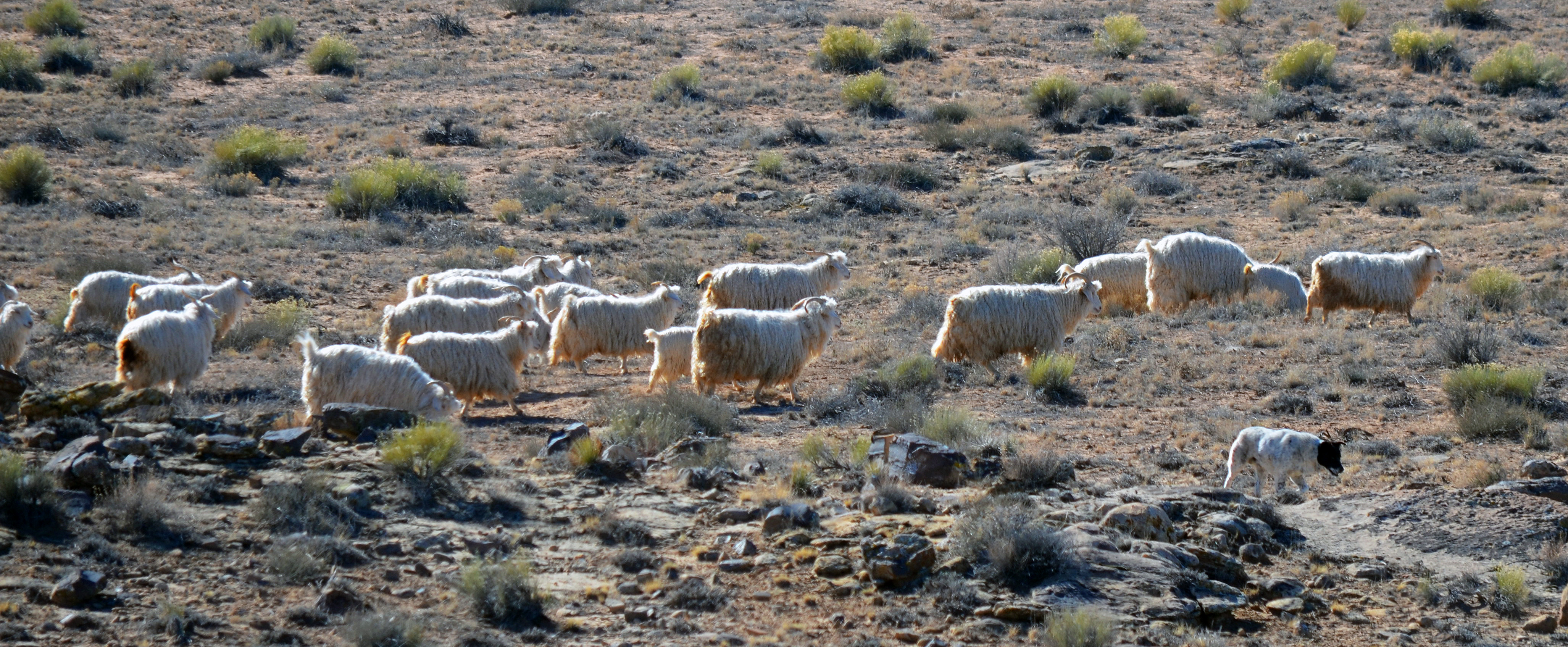
Our one goal today was to take a 5-hour detour of our planned route and travel northwest to visit the Four Corners Monument on the Navajo Reservation. Owned and operated by the Navajos, this unique attraction in the middle of nowhere, is the only place in the U.S. where you can stand, or actually kneel, in four different states at the same time-Colorado, Utah, New Mexico and Arizona. While we were there we met some very nice Navajo women, including Lynn who creates hand-crafted paintings of their customs and beliefs on sandstone, along with a complete written story of each, and Barbara and Daisy who provided us a fresh-made Navajo Frybread to eat (kinda like a funnel cake). We had a very enjoyable conversation with Barbara who shared with us that her cousin actually moved to Philadelphia 40 years ago, and about her Angora Goats, which she had brought with her, and were out grazing as her dog watched over them. Tyler and I really enjoyed speaking to them and learning a little about their proud, Navajo history. We both said that we want to return and spend some more time here!
Barbara’s Angora Goats and their watchdog graze at Four Corners.Pronghorn Antelope watch us carefully as we snap their photo in northern AZ
As we ended our day in Flagstaff under clear skies and a full moon, we were treated to a great visit (and delicious meal) by my dad and Joyce, who had traveled north from Tucson for a few days and meet up with up his son, and grandson! Thanks Pa! We Love You!
Three generations of Wood guys meet up in Flagstaff, AZ!
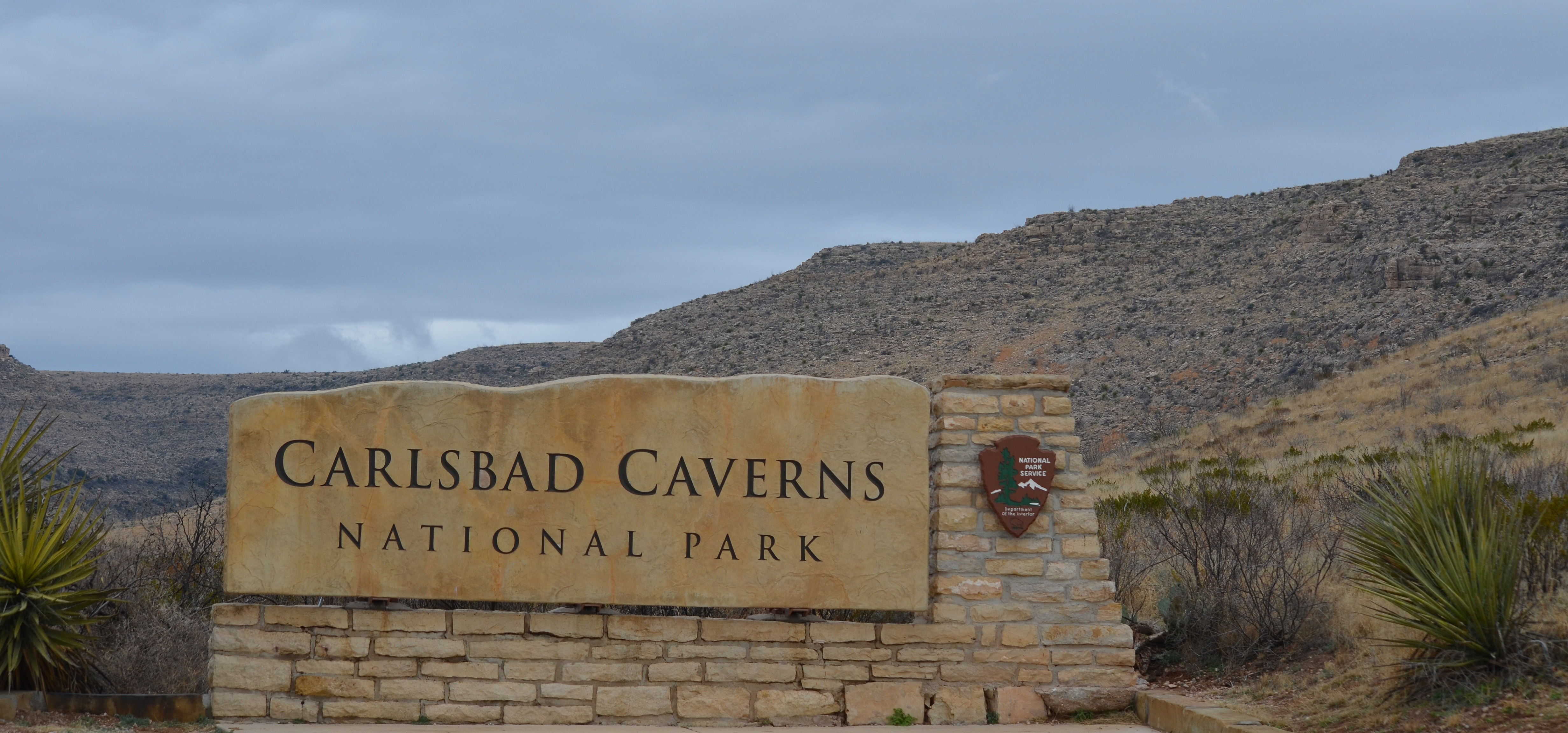
As we looked out over the mountains and grasslands of the Chihuahuan Desert of SE New Mexico, we couldn’t help wonder what lied beneath-we were about to find out. Day 4 brought us to Carlsbad Caverns National Park in the rugged Guadalupe Mountains. We descended almost 800 feet below the surface to start our guided tour of these caverns, only one of 119 found in the park.
Before the tour began, Tyler and I had a good laugh. Ty had gone over to another area to check something out, and I remained standing at our tour meeting spot. I noticed two other people standing about 20′ away from me, with a man holding a camera and cell phone. As Tyler returned, I watched him walk in the direction of the man holding the camera, with his wife next to him. I knew exactly what was about to happen and being the good dad that I was, I just stood there and let it play out, while holding back my laughter. He walked right up to the guy, stood next to him and started talking to him, as if it were me. Before the guy could say anything, Tyler paused looked at him, then glanced over and saw me, as he said, “Sorry'” and mumbled something else as he embarrassingly walked back to me. I burst out laughing, and he even chuckled a bit, too. The two people were cool about it and got a laugh at it as well.
The caverns were awesome! So many different formations, in such rooms as The Big Room, The Kings Palace (the name of our tour) and the Queen’s Chamber. The tour was about 1-mile in length as we walked, and ducked through a few tight corridors that opened up into some impressive sights. This is one of those natural wonders that you must experience in person. Pictures and video just can’t do it.
Our last stop of the day was Roswell, the location of the (alleged) biggest alien cover up ever. It was here in 1947 that supposedly an alien space ship crashed out in the desert, but the military denied the event and quickly came in to “clean everything up and take what ever was found, including alien bodies.” Whatever your opinion may be, there were a few witnesses who came forth to say they had seen the crash site, parts of the spaceship and the top secret military who took over the entire incident. Today, there a few businesses that embrace the entire alien crash story, including the International UFO Museum and Research Center. For $5/person you can read/view all about this historical event, plus learn about alien abductions, crop circles, and every other aspect of UFOs. It was truly an educational, and entertaining, visit! I believe, just like I believe the Boggy Creek Monster roams the swamps around Fouke, AR!
Tyler-about to be abducted by aliens!
Someone asked me about seeing any wildlife along the way. We’ve seen very little in the routes we’ve chosen, and it’s not due to a lack of looking. We saw one Mule deer in someone’s yard yesterday, but that’s just about it. The only “consistent” wildlife we’ve see are Red-tailed Hawks-lots of them.
A Red-tailed Hawk hovers in Carlsbad Caverns NPA Great-tailed Grackle calls to me outside our hotel
Texas. It’s big, really big. Day 3 was all about Texas. Since 3pm on day two, we had been crossing the Lone Star State. Although we had several stops and did not cross it at its widest point, we still put in over 8 hours of driving time, just in Texas! That’s the equivalent of driving from our home in Pottstown, PA, west to Harrisburg, then south through MD, WV, VA and into TN in one day! The highlight was our visit to the famous Fort Worth Stockyards, with a quick stop to check out Billy Bobs, the Worlds Largest Honkey Tonk. Although the huge bar and dance hall had just opened for the day, they let Tyler and I in to have a looksee and snap a few photos. It’s quite a bar, and we wished we could have stayed for a Saturday Night celebration, including live bull riding!
As we left Billy Bobs, we stumbled upon a daily (actually, 2x/day) event that happens in the stockyards-a short cattle drive down main street. Several Texas longhorns are led down the street by cowboys, passing very close to BMWs and minivans that are parked along side. We got a chuckle at one point when one of the cowboys shouted to another that “Chet,” a large-horned cow in the back of the herd, was slowing all the rest of them down, and Chet needed to pick up the pace. We watched Chet closely after the dressed cowpoke hollered, and we think he actually smirked, and slowed down even more, just to piss the riders off a bit. Chet did speed up a little when another cowboy rode back and showed him the steakhouse they were all trotting by!
Chet, the rebellious longhorn!
After leaving Fort Worth, we began our long trek across West Texas. If you’ve ever been to West Texas, you know the landscape is not very exciting to look at. I know that every environment has its own natural beauty, but today, the last day of January, in dreary, rainy weather, we did not witness much of that beauty. Yes, we saw an occasional kestrel perched on a wire, and a raven or two, but that was about it for 5 hours. What we did see were oil and gas wells. Hundreds and hundreds of them dotted the landscape for a hundred miles on both sides of the highway. We didn’t even see a roadkill of any kind! We did catch sight of a single Eurasian Collared Dove in Big Spring. We think it was a Lonesome Dove!
Our last stop of the day may have been the most interesting. We learned that there was a replica of the Worlds Largest Paper Airplane in Abilene, and we HAD to go and see that! We finally found it in the backyard of a small art gallery, except the gallery was closed with a locked gate. So, we noticed a gas station right next door where we could park and sneak a look/photo over the broken down fence. I did notice the No Trespassing signs and respected them. Tyler had ran in to the mini-mart to quickly use the restroom, while I used my stealth skills to sneak a picture. After snapping a quick pic, I noticed a man walking straight toward me, from the direction of the closed art gallery. Uh Oh! Was I busted? The man came right up to me, as Tyler came walking over. I asked him if the gallery was going to open. He walked within three feet of me, stopped and said, “I don’t know, are you supposed to be meeting me?” I looked at him, then at Tyler, then back at him, with a puzzled look on my face. I noticed he was holding a wad of cash in his hand. When he spotted my camera, he quickly turned, and walked away to a waiting car. Tyler looked at me with a weird smile and asked, “Was he trying to by drugs from you?” “Dad, I think you just broke up his drug deal-you obviously weren’t the one he was hoping to see!” Tyler said, half laughing. We jumped in the Prius and left Abilene and Texas in the rear view mirror, heading for NM border. What a day!
Replica of the Worlds Largest Paper Airplane. This odd visit prompted an impromptu, unsuccessful drug deal that caught Tyler and I by surprise!
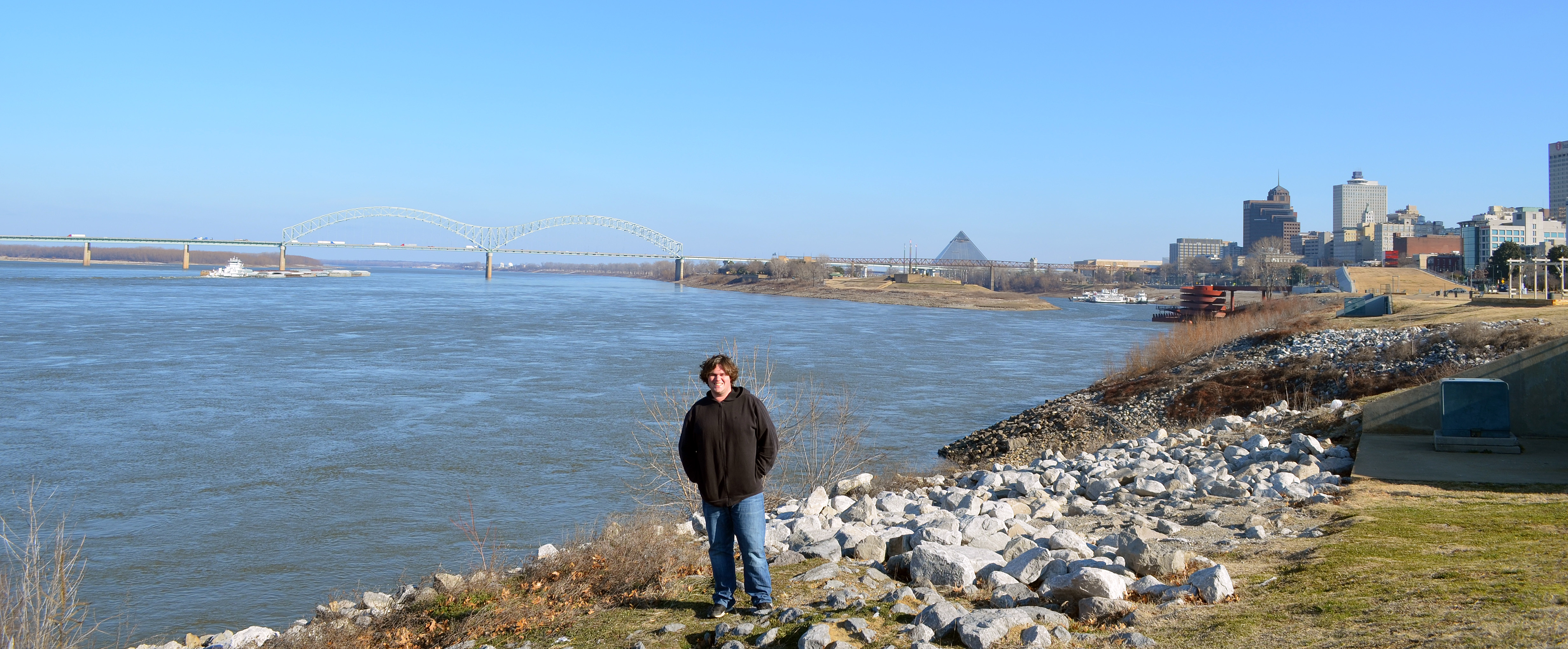
After a long first day, it was time to slow down and experience some of the attractions that awaited us. We began a beautiful, sunny day with a short walk along The Mighty Mississippi River in Memphis. They have several great parks along the river that include bike trails and fitness stations. Tyler and I just kinda stood and watched a tug pushing a large load of barges up river for a few minutes. I got a bit tired watching a few people working hard on the fitness stations and had to take a short rest!
You cannot visit Memphis without seeing Graceland-the home of Elvis Presley. It doesn’t matter if you not really in to his music, but to see where and how The King lived, is worth the time and money. The influence he had on Rock and Roll will never be debated. All that being said, Tyler and I thought how the tour was conducted, was, well, a bit weird. We’ve both been on “audio tours” where they give you a set of head phones to listen to some person narrating information about what you’re looking at, but on the Graceland Tour each visitor also gets an iPad, fitted with a strap to hang around your neck. They hand you this fancy, electronic screen that you put on, open up and rest against your chest, or in some cases, against your belly. After choosing the appropriate language (I really wanted to try the entire tour in Russian, but decided to stick to my native tongue) you begin walking exactly where strategically placed staff people tell you to walk. There we were, along with 50 other people, walking around like interpretive zombies with these gadgets sticking out of the front of our bodies. I swear we all could have been selling peanuts or popcorn at the ball game! It’s quite the system they have unless you decide to skip one of the attractions, which we discovered was a no-no! Our iPad narration (by Full House Actor John Stamos of all people?) got all out of whack and we couldn’t figure out how to “fast-forward or “rewind” the damn thing. When we realized we couldn’t go back, so we simply walked ahead of the rest of the others, only to be scolded by the security guards! It was rather amusing, but all worth it!
Tyler prepares to enter Graceland with his “peanut-selling” iPad hung around his neck.
As we left Tennessee and made our way through Arkansas, I had only one destination on my mind-Fouke, Arkansas, home of the Legend of Boggy Creek, the Fouke Monster!
Now if you’ve never heard of the Legend of Boggy Creek, let me you fill in. It’s a basically an Arkansas Bigfoot. A classic movie (half documentary-half not) was made about the creature in 1972. My brothers and sister and I went to see the original movie in the theater, and as an 8-year old, I was scared beyond belief. I never wanted to wander into the woods again, and never looked out a window at night after that! Today, the “performance” may seem a bit cheezy, but to a certain 8-year old kid from PA, it became a lifelong source of wonder (no, I did not say obsession) and pure awe! When we stopped by the Monster Mart today to buy a few Boggy Creek souvenirs, we were greeted by the owner who began telling Tyler and I about how all the items are made, etc. I then asked him if anyone had seen the creature recently, and that’s when I got excited! He began to describe, in detail, a sighting that happened just last week, only a few miles from where we were standing. The hair on the back of my neck stood up and I accidently blurted out, “Can you take us to that spot?” I knew I had made a mistake asking, but couldn’t help myself. He stood there looking at me as if I was the actual creature, then politely replied, “No, I’m sorry, that’s private property. They don’t like strangers wandering around out there.” I was bummed, but still thrilled to hear his story. Cathy-we need to return w/Bobo to do our own investigation! Check a big one off my bucket list!
Our last stop of the day was the Texarkana Court House and Post Office-the only place where a state line runs right down the middle of the building. Yep, half the building is in Texarkana, TX, and the other half is in Texarkana, AR!
We learned a very tiring stat today! The state of TN is over 500 miles wide-that’s a long drive for an eastern state!
Well, we’re underway! It was all about driving and getting south on Day 1. No stops, other than some eats and bathroom breaks. After 15 hours and five states, we managed to safely arrive at our planned destination for the first night-Memphis, TN. Sister Cathy, you were correct! Damn! Tennessee is a long state from east to west! Especially after already driving 7 hours! This state is 150 miles wider than our home state of PA!
I have to confess, I had a brief senior moment as we started out this morning at 3:30 am (having had no coffee yet). I accepted the challenge of driving the first leg (Tyler’s Prius). As I approached the Turnpike toll booth, with no other souls in sight, I pulled up and waited for the ticket-nothing. I looked around for a human, but I’m pretty sure they were simply closed! After another minute of sitting there staring at the thingamajig that spits out tickets, I reached out ready to push the button for help. Tyler then sat straight up in his seat, looked at me and said “It’s green-go! I have an EZ Pass.” I really didn’t have any good response, other than, “Really? When did you get that?” I swiveled my head to take one last glance to make sure there still wasn’t a slip of paper sticking out of the ticket thingamajig, made sure no one was watching us, then floored it! I knew this was going to be a long drive!
The sun sets on Nashville as we zoom on by, on I-40, headed for our destination of Memphis.
Tomorrow, we start checking out some sites-some well known spots (“thank you-thank you very much”), and some spots off the beaten track. Check back for our next entry! Good Night from Memphis!
Now you see them, now you don’t. The birds visiting our backyard bird feeders disappeared in the blink of an eye. One minute we were watching the chickadees, titmice, juncos, doves and cardinals enjoying their seeds, the next minute we look out the window there’s not a single bird anywhere-gone in 60 seconds! It’s not unusual to see them perform this vanishing act at this time of the year-some days several times throughout the day. Occasionally, we’ll see a clue as to what caused the sudden panic to fly away, in the form of a pile of feathers laying on the frozen ground. What causes these pretty, little songbirds to scatter and hide in a dense shrub or evergreen tree? A bird feeder!
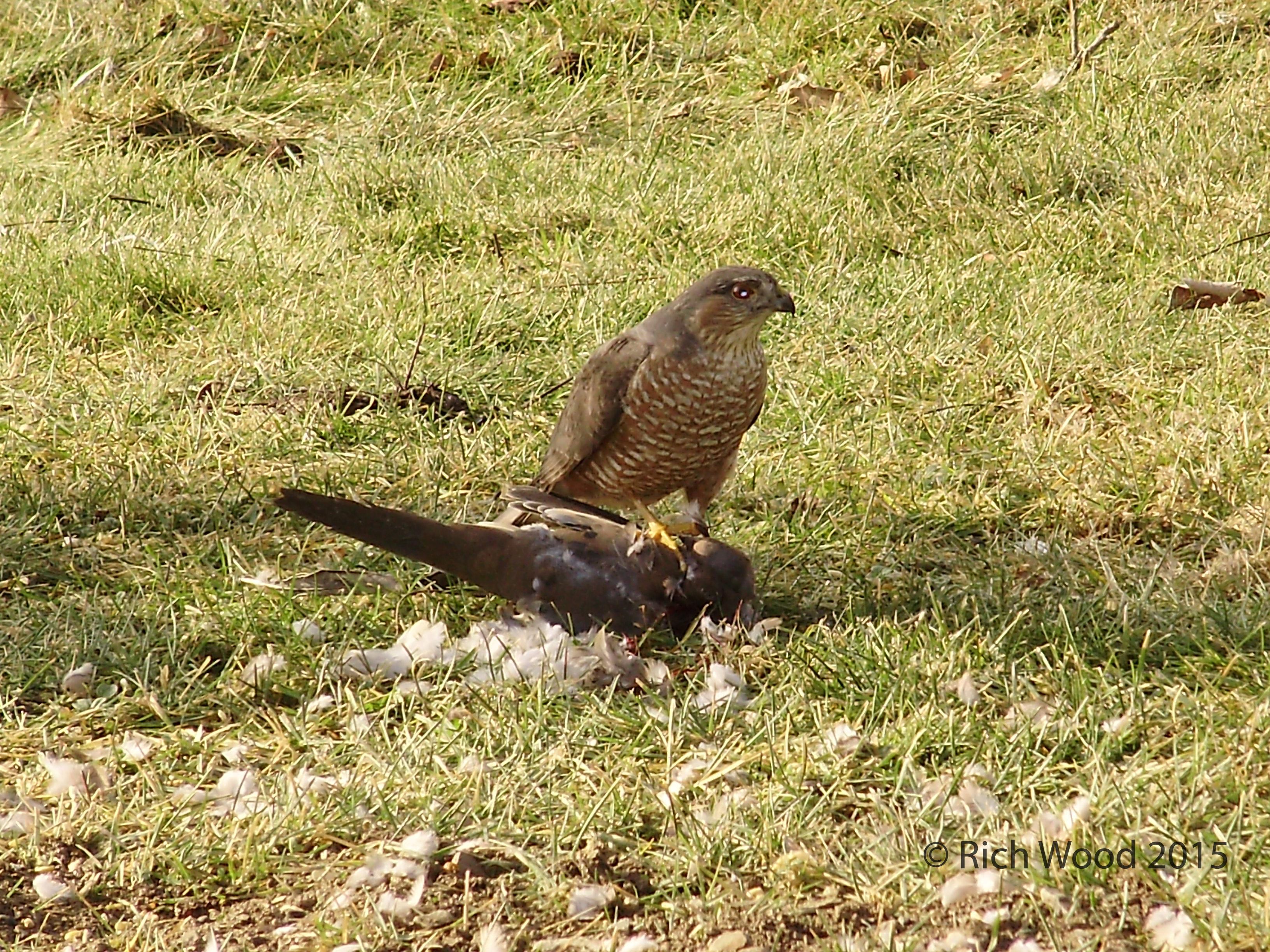
A Sharp-shinned hawk sits on a bird feeder after missing his target
Bird feeders come in all shapes and sizes. But, this feeder isn’t an ugly, wooden or plastic object hanging in a tree I made myself, that scares the little birdies away every time the wind blows. This bird feeder is alive! It doesn’t provide seed for other birds, it feeds on other birds. In fact, it is a bird. Specifically, the bird feeder is a Sharp-shinned hawk.
Sharp-shinned hawks, or “sharpies” as they’re nicknamed, are one of three species of hawks classified as Accipiters. These forest-dwelling raptors are characterized by having short, round wings and long tails, which allow them to fly in between trees with speed and accuracy. There are three species that occur in North America, including Pennsylvania. The largest is the Northern Goshawk and the smallest is the Sharp-shinned hawk. The other is the Cooper’s hawk.
A Cooper’s hawk pauses after catching a Robin for breakfastAccipiters show short, round wings and a long tail when flying
What makes these hawks unique from other birds of prey is their aggressive appetite for other birds. Sure, they’ll also eat mice and squirrels and other small mammals if they’re sitting there staring at the hawk, but their reputation as efficient, flying predators gives them an advantage of capturing songbirds. Many times, when one of these critters visits your backyard bird feeders, they may decide to stick around for a day or two, only showing up sporadically, but always perched nearby watching your feeders, and waiting patiently to attack.
It can be rather entertaining watching the small songbirds react to a “sharpie” or a Cooper’s hawk that suddenly appears out of nowhere to try and grab them while they’re sitting there, unsuspecting, and minding their own business cracking open a sunflower seed. Like someone blowing the seeds of a dandelion head, birds flee in every direction! I’ve seen them fly into each other, hit branches and even run along the ground to get away as quick as possible. Most of the hawks’ strikes are misses, but when they do hit, it’s usually one of the bigger species that gets it, like Mourning doves or Northern cardinals. I can see why they target these two species, though. The doves are chunky, and a bit awkward when trying to take off quickly. Male cardinals, unfortunately, are bright red. Need I say more? If the hawk is successful, it doesn’t take long for the other fortunate birds to begin to return, peeking out of the bushes as if to say, “Who got it?” While others seems to reply, “Who cares, it wasn’t us, let’s go get some cracked corn!’ Bird feeders-you got love em’!
A plump Mourning dove falls victim to a hungry Sharpie
Last Saturday it was gorgeous outside. Sunny, very warm temps and blue sky, and then, for about 45 minutes, it began to snow! However, the snow was not cold and did not stick to the ground. It was feathered, landed on the ground, flew above the ground, circled in the sky overhead and was extremely noisy! It wasn’t actually frozen precipitation, the “storm” was a large flock of Snow geese-approximately 20,000+.
I was standing near a cut corn field in Berks County, as the thick, gale of birds descended into the field from every direction. The blue sky was dotted with loud, white objects that looked like twinkling stars against an indigo background. There were so many I didn’t know where to focus my camera. The excitement caused me to drop one of my lenses and it nearly rolled into a groundhog hole I was standing next to. For nearly 30 minutes, they kept coming, instinctively knowing their safety was in their numbers. I felt like I was in the bubble of a snow globe that someone had just shaken. It was an awesome sight!
Snow geese (Chen caerulescens) are only visitors to Pennsylvania, passing through our state during their southern migrations in late fall/early winter, and then again in the spring as they head back north. They overwinter in the coastal wetlands, bays and flooded fields in the Mid-Atlantic States and Carolinas, as well as parts of Texas and into Mexico. In the Pacific Flyway they winter in the mild, farm valleys of Washington and Oregon. Where do they come from and return to? The Arctic tundra in Greenland, Canada, Alaska and parts of Siberia. This is where the geese breed and raise young during the short Arctic summers.
If you could see these large flocks, you would never believe their population was once at critical levels in the early 1900’s. Their numbers dropped so low that hunting was banned for the species in the Eastern U.S. Since then, they’ve staged an incredible comeback. In fact, their population has grown so sizeable that they’re eating themselves (and other species) “out of house and home” in their tundra habitat. Snow geese, like other geese species, are grazers. They eat grasses and many other low-growing forbs, and will munch any part of the plant including the leaves, stem, seed, flower and root.
Thousands of Snow Geese dot the blue sky like stars twinkling in the night sky
As I stood there staring in wonder at the thousands of large, white (and slightly black) birds flying and cackling all around me, I couldn’t help thinking that I was experiencing a blizzard of feathers, a snow storm of geese!
My alarm went off promptly at 5:00 am. I tried to hit the snooze, but then realized my watch did not have a snooze, and I knocked it off the night stand. It landed somewhere in the darkness of the bedroom, still sounding the steady, soft beeping. I opened my door, stumbled toward my sister Cathy’s room to gently yell to her to get up, but she was already headed toward the coffee pot in the kitchen. It was time to get up. It was owling time!
Believe it or not, we were probably part of thousands of volunteers that were getting ready to head outdoors well before sunrise in search of a few nocturnal birds. We were participating in National Audubon’s Annual Christmas Bird Count-the longest running citizen science project in the world. The 2014 count marks the 115th year of collecting bird data that tracks long term population changes. Cathy and I volunteered to help in our home area, as part of the Bloomsburg Christmas Count.
What is a Christmas Bird Count? It’s just as its name implies-a bird count that occurs during the Christmas season (not actually on Christmas Day). Small groups of volunteers travel in assigned areas within a pre-determined, 15-mile diameter circle and record every bird they see or hear. The one day count happens between December 14, 2014 and Monday, January 5, 2015. Why do we do this? It’s fun, it gets us outdoors, we see lots of birds (and other critters), we meet new people and we’re contributing to a very worthy project!
Count data over the years has shown that Northern Mockingbirds, a species rarely found in the winter in PA a decade ago, are now commonly found all year-round.
If you decide to participate in a Christmas Bird Count there’s a few items you should have in your “toolkit.” First, a bird book and a decent pair of binoculars to see the birds. They shouldn’t have double vision or you’ll be counting every bird twice! Also, if they come with caps to cover the eye pieces, it usually helps if you remove them first, or everything you try to view will look like an extreme close-up of a blackbird! Next, is coffee and snacks. Coffee keeps you warm and keeps you going! When it comes to snacks, don’t be too picky. Apples, granola bars, peanuts, cookies, banana muffins, chips, pretzels, beef jerky and anything else you can pick-up at the local convenience store or get a sister to bake! For some unknown reason, counting birds makes you hungry, and you find yourself nibbling just as often after seeing a Red-tailed hawk for the first time that day, or seeing your 850th European Starling. Next, you should bring lots of water to drink. You get very thirsty eating all those snacks. Also, if you’re covering an area that’s fairly rural and with no public restrooms nearby, I would recommend a roll of toilet paper. Why? Coffee, granola bars, peanuts, cookies, banana muffins, Doritos and beef jerky! Need I say more?
Some of the essential items you can carry while participating in the Christmas Bird Count.
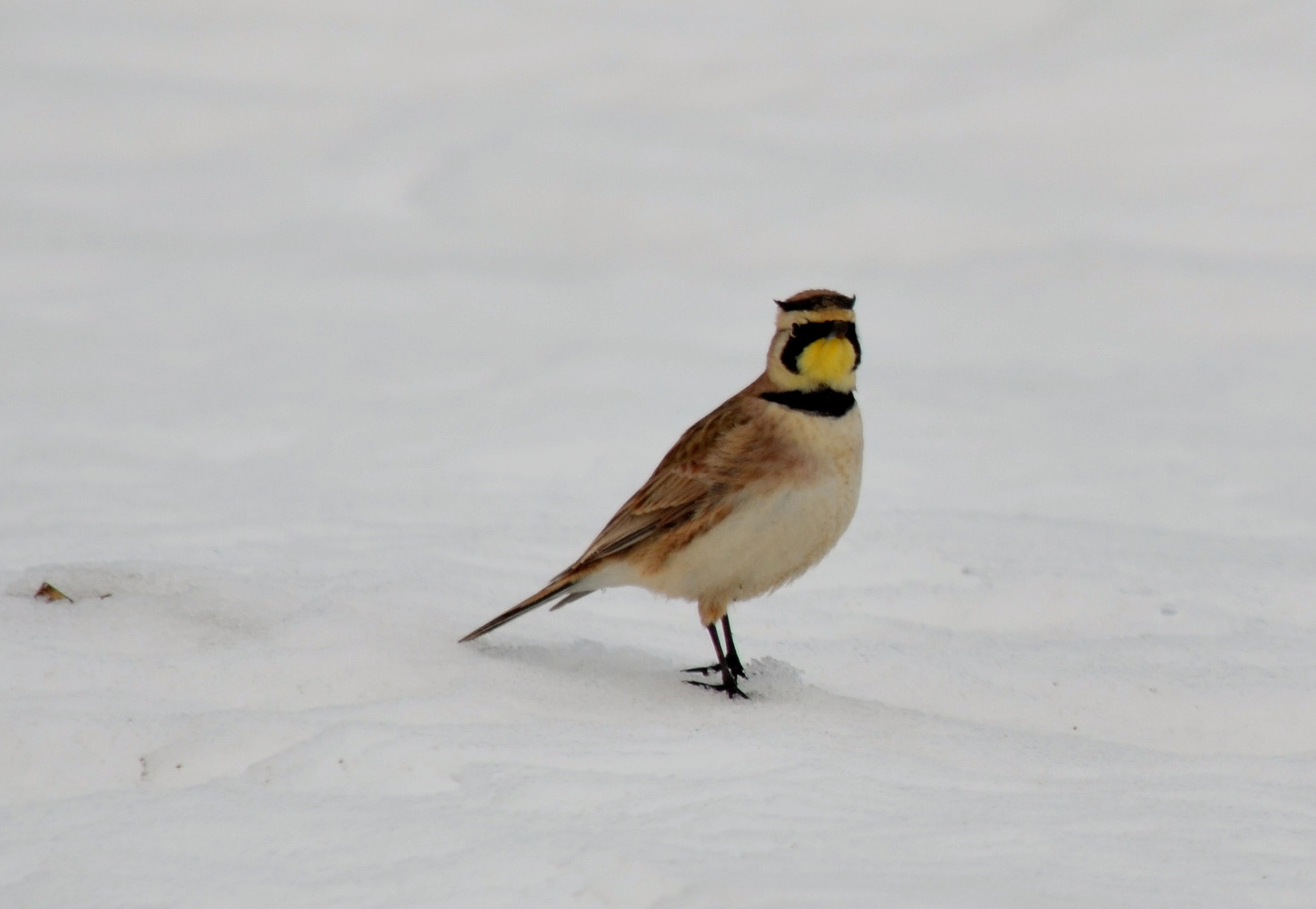
We only managed to see 29 species of birds, but counted almost 1000 (many Starlings and Pigeons)! We were fortunate to find a small flock of Horned Larks after much looking, had good looks at Bluebirds, Mockingbirds, American Kestrels and lots of juncos and sparrows. Sister Cathy spotted a Northern Harrier taking off just in front of us. A good find in any count! It really didn’t matter how many birds we observed, we had a great time, saw lots of critters, traveled through some beautiful areas and had the opportunity to spend some time with some old friends, and many dedicated volunteers. It was a great, early Christmas present, and I can’t wait until the 2015 “count season!”
A Horned Lark stands on a patch of snow.An American Kestrel watches for mice from the top of a tree.
If you’re one of the millions who choose to put up a live Christmas tree each year, what are your reasons for selecting the perfect tree? Is it purely the species, like a Fir or Pine? Is it based on the size, shape and fullness? Does the scent (smell) of the tree have anything to do with it? Or, is it merely a matter of economics-who is it selling them for the cheapest price? Whatever your criteria, picking out that flawless tree can become quite a quest! Even more so, if you prefer to cut your own.
In the days immediately following Thanksgiving, it seems like small herds of fresh cut Christmas trees begin migrating to every corner, vacant lot or large parking area. Signs of all sizes appear at intersections directing you to drive 10 miles out of your way for the “best selection.” Christmas tree farms are a huge agricultural industry, with much of the business conducted in about 6-week season.
Live, cut Christmas trees begin appearing right after Thanksgiving.
Cutting your own tree has become quite a trend in recent years. In our area, there is at least a half dozen Christmas tree farms that go all out for your visit. When you arrive, you’re greeted with a cup of hot chocolate and then guided to a tractor-driven (or horse-drawn) hay wagon that will carry you to a field full of natural, emerald-colored evergreens waiting to be cut. To top it off, you can finish your outing with a quick stop in their Christmas shop to purchase an ornament or wreath to compliment your new tree. It’s truly an all-day experience! However, the “experience” of cutting your own tree certainly has changed over the years.
In 1975, my oldest brother, Jimmy, pioneered a legendary approach for obtaining your own live Christmas tree. It was short-lived, but extremely resourceful and quite entertaining! He recruited (bribed?) my sister Cathy and somehow convinced Pa they could handle the task of acquiring a live tree for the Wood Family Christmas. After trekking through our back woods, my brother declared he had found the perfect tree-it didn’t really matter that it was 40 feet above their heads! You see, his plan was to climb a large Hemlock and cut off the top 8 feet, since the top seemed to be just what we needed in our living room! So, with the skills of Paul Bunyan and handsaw slung over his back, he ascended, branch after branch, until he reached his goal. After a few quick strokes of the saw blade, our new tree came crashing down to the ground, scattering birds and squirrels in every direction and sending my sister diving for cover! Not until they dragged it back to the house and squeezed it through the door, did Jimmy discover it was about 5 feet taller than our living room ceiling. Nothing that a few strokes of the hand saw couldn’t fix! We’ll always remember that Christmas as the year Jimmy re-defined “trimming the tree!”
In 1975, we discovered that the top of a Hemlock, similar to this one, may not be the best choice for a live Christmas tree!
Today, many large U.S. cities also put up live trees to celebrate the holiday season, including New York City’s famous Rockefeller Center. As a matter of fact, this year’s Big Apple tree came from right here in Pennsylvania, a towering 85-foot Norway spruce from Danville. The White House, too, looked to PA for its honorary tree in 2014. An 18’ Douglas fir, grown at Crystal Springs Farm in Lehighton, has been named the Grand Champion tree and will be displayed in the Blue Room. In the Keystone State, Christmas trees are grown in every County except Philadelphia, and Pennsylvania ranks in the top five states in the U.S. for number of trees grown.
An added benefit of real Christmas trees is the habitat they provide for wildlife. While growing in the fields, many species of birds may use them for nesting sites. After the holidays, they can be recycled by putting them back outside to act as cover for wintering wildlife, or having them chipped into mulch. Of course, all those growing evergreens also help in providing oxygen for people to breathe. Whatever your vision of the perfect tree might be, don’t wait too long, before you know it, all those “premium cut trees” will be gone! Good Luck with your search!
Northern mockingbirds may use Christmas trees to nest in, and search for insects to feed their young.